Demat AMC means account maintenance charge: the fee for keeping a demat account, separate from opening fees and charges on a trade. The word “free” answers three different questions: opening an account, its first year, and maintaining it later. For a standard resident-individual account, the four brokers below publish different later-year terms. BSDA eligibility can erase or reduce AMC even when the regular tariff has a fee.
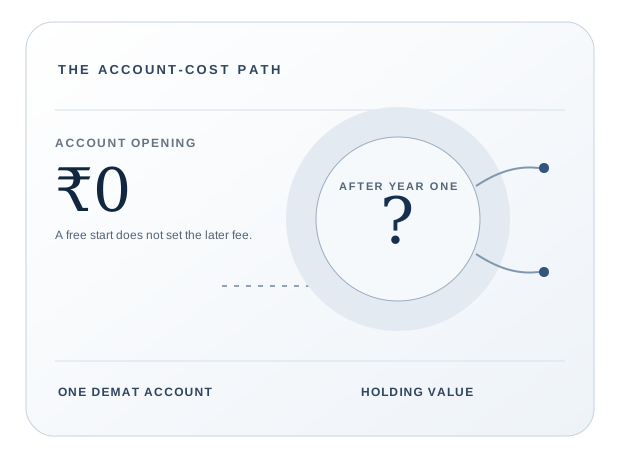
We use annualized published rates including 18% GST where the broker adds it. They are not a total cost of investing: brokerage, DP debits, taxes and optional services sit outside this guide. See how a delivery sale can add a DP charge ↗
“Free account” can mean three different things.
An account-opening charge is paid, if applicable, when the account is created. Annual maintenance charge is for keeping a demat account. A DP debit can be charged when securities leave it on a delivery sale. These three events are different. A page saying “₹0 account opening” does not establish the maintenance cost in year two. A ₹0 AMC schedule does not make a delivery sale free.
Opening a demat account to apply for an IPO? Separate the cost of keeping the account from the structure of the offer. Our fresh issue vs OFS guide explains who receives the IPO money; the maintenance schedules here answer what keeping your account may cost.
Was there an opening fee?
What AMC applies after a waiver?
Will a delivery debit add a DP fee?
Imagine buying a security and holding it all year. No delivery-sale debit occurs, but an AMC could still apply. Another investor may pay no AMC yet incur a DP charge when selling. Combining these into one “free or paid” label makes it impossible to see which part of the tariff caused a bill. The DP charges guide deals with the sale; this guide isolates maintenance.
Even “annual” needs interpretation. It gives us a common twelve-month basis for comparison, not a promise of one yearly deduction. Zerodha describes quarterly debits about every 91 days. Angel One quotes a quarterly rate that is charged after the first trade in a quarter. A yearly total helps compare the schedules, while the collection rule helps explain a ledger entry. Zerodha billing terms ↗ Angel One billing terms ↗
Check BSDA before comparing prices.
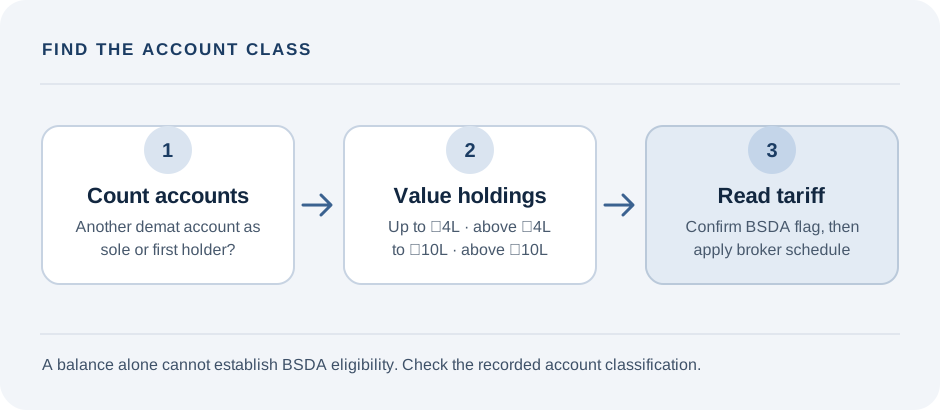
A Basic Services Demat Account (BSDA) is a reduced-cost account for eligible holders. The published broker rules here depend on whether you have another demat account as sole or first holder and the value of your holdings. SEBI's December 2025 update requires depository participants to reassess eligibility every quarter and convert eligible accounts unless the holder actively opts for a regular account. Read the SEBI circular ↗
₹0 AMC under each of the four published schedules below.
Up to ₹100 a year before GST; each of Zerodha, Upstox and Angel One publishes ₹118 including GST. Groww lists ₹0.
More than one account where you are sole or first holder, holdings above ₹10 lakh or an active regular-account choice can change the applicable schedule.
Unsure how many accounts you have?
Check your latest Consolidated Account Statement (CAS) for demat accounts linked under your first-holder PAN. CDSL says the CAS combines holdings and transactions across CDSL and NSDL accounts using the PAN and holder details. CDSL says a CAS is not generated for every account pattern. If you do not receive one, an expected account is missing, or you need to confirm whether an old account is still open, ask the relevant depository participant for a current statement or account status. How the CAS is compiled ↗
Account classification is the hinge. Zerodha says you can inspect the BSDA flag in its client master report; Angel One points to its client master list. If you are sole or first holder of accounts with more than one broker, check the classification at each broker rather than applying a low-holdings slab automatically. Zerodha eligibility ↗ Angel One eligibility ↗ Upstox BSDA terms ↗
The second account changes the first calculation.
The BSDA facility is intended for eligible individuals with only one demat account as sole or first holder across depositories. Its value slabs are not a blanket discount for every account with a small portfolio. Suppose an investor holds ₹6 lakh in one eligible demat account. That falls in the upper BSDA band. If the same investor opens another account as sole or first holder, the single-account condition can fail even if neither account individually holds ₹10 lakh. Zerodha's support page explicitly says that having multiple demat accounts can result in regular AMC on both its accounts. SEBI BSDA framework ↗ Zerodha account rule ↗
SEBI's December 2025 circular requires depository participants to reassess BSDA eligibility every quarter. It also calls for active, verifiable consent when an eligible investor chooses to remain on a regular account. That is a reason to recheck an old classification, but it is not a reason to assume every account under the value threshold automatically qualifies. The other conditions still apply. SEBI update ↗
The threshold concerns the applicable value of securities, not merely the money originally invested. Market prices can move a portfolio close to ₹4 lakh or ₹10 lakh across a boundary without the owner making a trade. SEBI says suspended securities may be left out of the BSDA value test. Its December update excludes zero-coupon zero-principal bonds and delisted securities and specifies a last-closing-price rule for illiquid securities. If your own rough portfolio estimate disagrees with a broker's BSDA flag, ask the depository participant which holdings and valuation date were used instead of guessing from the app's headline balance.
The practical question before opening a second account is not “will the new account be free?” It is “what happens to the combined cost of both accounts after any first-year waiver?” A new broker might still provide a service worth paying for. The AMC effect should be visible in that decision, not hidden in the old account's next quarterly debit. Conversely, do not close a useful account solely on the arithmetic without checking the transfer, closure and service implications.
What changes after the first year?
These are the brokers' stated resident-individual AMC schedules, annualized for comparison. The BSDA columns assume the account qualifies; “regular” means non-BSDA. All numeric rates include GST where applicable.
*Angel One assumes four collected quarters; its tariff describes a first-trade-per-quarter condition. The bars are account maintenance only, not total investing cost.
Zerodha
Official tariff ↗The first-year waiver applies to eligible primary resident-individual accounts. Then ₹25 + GST quarterly in the upper BSDA slab or ₹75 + GST quarterly for a regular account.
Groww
Official tariff ↗Groww publishes zero account-maintenance charges on its pricing page.
Upstox
Official tariff ↗₹100 + GST yearly in the upper BSDA slab; ₹300 + GST for a regular account after year one.
Angel One
Official tariff ↗₹100 + GST yearly in the upper BSDA slab; ₹60 + GST quarterly for non-BSDA, charged after the first trade each quarter.
* Angel One collection condition: its support page says the ₹60 + GST non-BSDA fee is billed quarterly after the first trade each quarter. ₹283.20 is four quarters of that published rate, not proof of what an account with no trades will be billed. Check the account's actual charge record before treating inactivity as a waiver. Read Angel One's wording ↗
Upstox's headline ₹0 AMC applies to newly onboarded users in year one. Its detailed pricing and account-opening pages specify ₹300 + GST for non-BSDA accounts later. The first-year offer on its pricing page applies to users onboarded from 14 February 2025. The account-opening tariff PDF ↗ also states “nil up to 1 year, then ₹300 + GST.” Read the year condition before comparing it with Groww's published ₹0 ongoing AMC. Upstox account terms ↗
Four accounts, four different answers.
These examples use the published later-year schedules after any first-year waiver has ended. They assume a resident-individual account and ordinary securities holdings. They illustrate how the rule works; a real account bill still depends on its recorded classification and billing period.
Below the first threshold
At ₹3 lakh of applicable holdings, an eligible BSDA is in the lower slab. Each broker in this comparison publishes ₹0 AMC. That does not mean the brokers have identical order pricing, DP debits or services. It answers only the maintenance question.
₹0 AMC across these four schedulesInside the upper BSDA slab
At ₹6 lakh, Zerodha, Upstox and Angel One publish ₹100 before GST, or ₹118 including GST over a year. Groww publishes ₹0. Quoting a regular ₹354 rate for this eligible account would overstate its scheduled AMC.
₹118 at three brokers; ₹0 at GrowwThe same holdings, a changed class
Once the single-account condition fails, the original account may move to a regular tariff. At Zerodha or Upstox, that illustrated account moves from ₹118 to ₹354, a ₹236 difference. The second account may carry AMC of its own. Compare the combined bill.
Check both accounts, not just the new oneAbove the BSDA value ceiling
Even with one account, ₹11 lakh is above the ₹10 lakh BSDA limit. The regular schedules become relevant: ₹354 at Zerodha and Upstox, ₹0 at Groww, and up to ₹283.20 in the four-collected-quarter Angel One model. Near-threshold values merit a fresh class check.
Read the regular tariff and billing ruleAt ₹6 lakh, “Zerodha costs ₹354” can be wrong for an eligible BSDA holder. “Zerodha costs ₹118” can be wrong for someone with another relevant demat account. Each rate is valid in a different case. This is why a price comparison should begin with the investor's account facts rather than the broker logo.
A second account can change the answer.
Take a resident individual with ₹6 lakh of holdings and one eligible demat account after any first-year waiver. The upper BSDA rate is ₹118 at Zerodha, Upstox and Angel One; Groww publishes ₹0. If the investor opens a second demat account as sole or first holder, the single-account BSDA condition may fail, even if each account holds less than ₹10 lakh.
*Angel One figure assumes all four quarterly charges are collected; its first-trade billing condition still applies.
That is a ₹236 yearly difference for Zerodha or Upstox's published schedules, before any other fees. It is a change in account classification, not a recommendation to close or avoid another account. Groww's published AMC remains ₹0 in these cases; other trade and service charges still matter. Zerodha schedule ↗ Upstox schedule ↗
Read the billing rule as well as the rate.
- Check the year. A first-year waiver at Zerodha, Upstox or Angel One does not establish year-two cost. Eligibility and the account-opening date matter.
- Check the account class. BSDA status can be reassessed quarterly. Another account where you are sole or first holder, or a move above the holding-value threshold, can change the schedule. SEBI update ↗
- Check when a charge is collected. Angel One describes a first-trade-per-quarter trigger for its regular-account AMC. Do not turn that wording into a blanket “free if idle” claim.
- Check the full investing cost. A zero-AMC account may have a different brokerage or DP schedule. Model the trading pattern separately in the Zerodha–Groww comparison.
We recheck this guide when broker tariffs or SEBI's BSDA rules change.
Compare a full year, not a single free month.
When weighing two accounts, write down the expected cost for a full later year. Start with the AMC applicable to the recorded class. Add any AMC for a second account. Keep brokerage and delivery-sale DP charges as separate lines until you have an estimate of how many orders and sales you expect. For example, an investor making no sales may have no delivery-sale DP debits, but a regular demat account can still carry AMC. An investor with a zero-AMC account may have the opposite pattern: no account-maintenance charge, yet repeated DP debits when securities leave the account. Neither profile is captured by a single “free account” claim.
Compare like with like. The ₹354 regular Zerodha and Upstox figures include GST and cover a modeled full later year. The ₹283.20 Angel One figure assumes its ₹60 plus GST quarterly charge is collected in all four quarters. Groww publishes ₹0 AMC. A first-year promotional waiver at one broker should not be set against another broker's later-year tariff as though they covered the same period. Likewise, the four-quarter annualization is a comparison device, not a prediction of the exact dates on which money will be deducted. Zerodha terms ↗ Upstox terms ↗ Angel One terms ↗
Price should also be read beside the service you intend to use. If a second account gives you access to a feature that matters, its extra AMC can be a deliberate expense. If it duplicates an idle account, the combined maintenance charge deserves attention before renewal. This guide does not assign a universal winner because the account-class rule, the number of accounts and the trade pattern can move independently. What it can do is make each input visible, so a reader can update the answer when circumstances or tariffs change.
How to check an actual AMC entry.
A published tariff is only the first document. For your own account, collect the opening date, the recorded BSDA or regular class, whether another account exists as sole or first holder, and the period covered by the AMC debit. A ₹0 opening-fee screenshot will not resolve a year-two maintenance charge. The account classification and charge record usually will.
A Consolidated Account Statement can bring CDSL and NSDL holdings together based on PAN and holder details. CDSL says it is sent monthly if there is a transaction in any demat account or mutual-fund folio and half-yearly if there is none. Some account patterns receive DP statements rather than a CAS. An absent or old CAS entry is not proof an account is closed; ask the depository participant for current status. CDSL CAS FAQ ↗
Look for the BSDA flag in the client master record or ask the broker to confirm the classification and its effective date. Zerodha describes this in its client master report; Angel One refers to its client master list. This is especially useful when holdings sit near a threshold or an account was once classified regular.
Read the funds ledger or charges section for the date, quarter and tax. Zerodha posts quarterly. Angel One points customers to Account → Trades and Charges → Other Charges, with a date-range selector. An annualized figure may appear as several smaller entries. Angel One charge lookup ↗
If the amount still differs, send support the opening date, class shown in the client master record, assessed period, holding-value band and exact ledger entry. Ask which tariff provision produced that entry. This gives the broker a concrete issue to investigate rather than a general complaint that an advertised account was “free.”
Do not assume a new debit always means the broker changed policy. It might be the end of a first-year waiver, the next quarterly collection date, a BSDA-to-regular transition or a different service charge. Likewise, absence of a charge in a short window does not prove the account has a permanent waiver. Match the published rule to the recorded account facts before drawing that conclusion.
Annualized arithmetic can help put the number in context: ₹354 is equivalent to ₹29.50 a month across twelve months, but that does not mean the broker bills ₹29.50 monthly. Two regular Zerodha accounts could have a combined published AMC of ₹708 including GST for four full charged quarters each. Their actual ledger entries depend on opening dates and billing cycles. Zerodha's schedule ↗