A decision guide for investors and traders: start with your own trade pattern, then examine published fees, account costs and product workflows. Fee sources checked 30 September 2026.
01 / SAME TRADENSE · EQUITY DELIVERY
BUY₹50,000SELL₹50,000
ESTIMATED TOTAL FEES₹0 BROKERAGE ≠ ₹0 COST
ZZerodha₹126.58
GGroww₹182.04
+ ₹55.46 IN THIS SCENARIOCHANGE THE INPUTS BELOW ↓
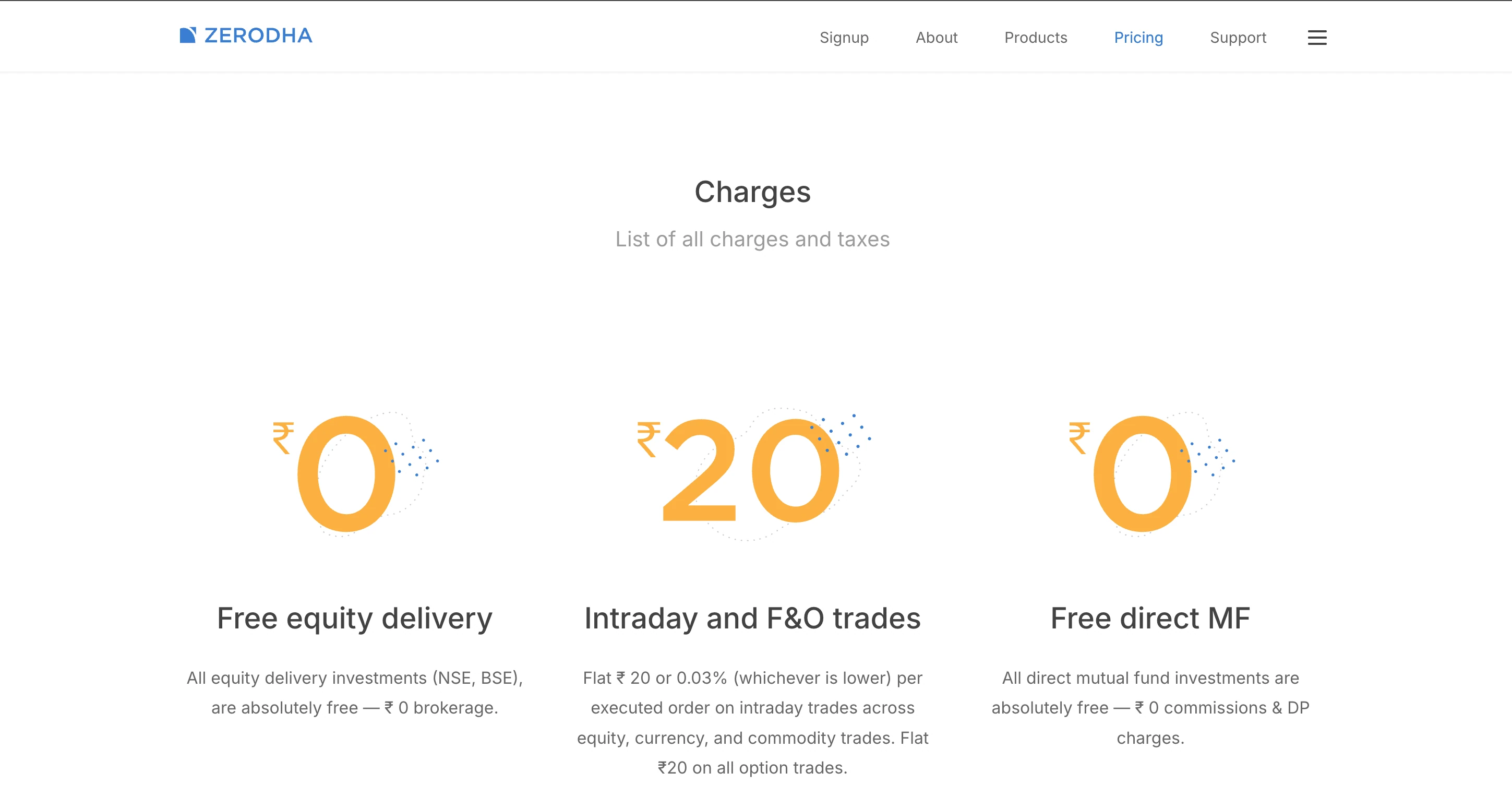
For an ordinary resident-individual account, Zerodha's zero delivery brokerage helps on repeated share trades. Groww's zero demat maintenance charge can matter more if you make very few trades. Use the cost comparison alongside the product and workflow details below.
01 / SAME TRADENSE · EQUITY DELIVERY
BUY₹50,000SELL₹50,000
ESTIMATED TOTAL FEES₹0 BROKERAGE ≠ ₹0 COST
ZZerodha₹126.58
GGroww₹182.04
+ ₹55.46 IN THIS SCENARIOCHANGE THE INPUTS BELOW ↓
01 / LONG-TERM INVESTOR
Count your sells. Then check AMC.
Zerodha lists ₹0 delivery brokerage. Groww lists the lower of ₹20 or 0.1% per executed order, subject to its minimum. A delivery sale can also create a DP debit: the standard male first-holder rate is ₹15.34 at Zerodha and ₹23.60 at Groww for a sale of at least ₹100.
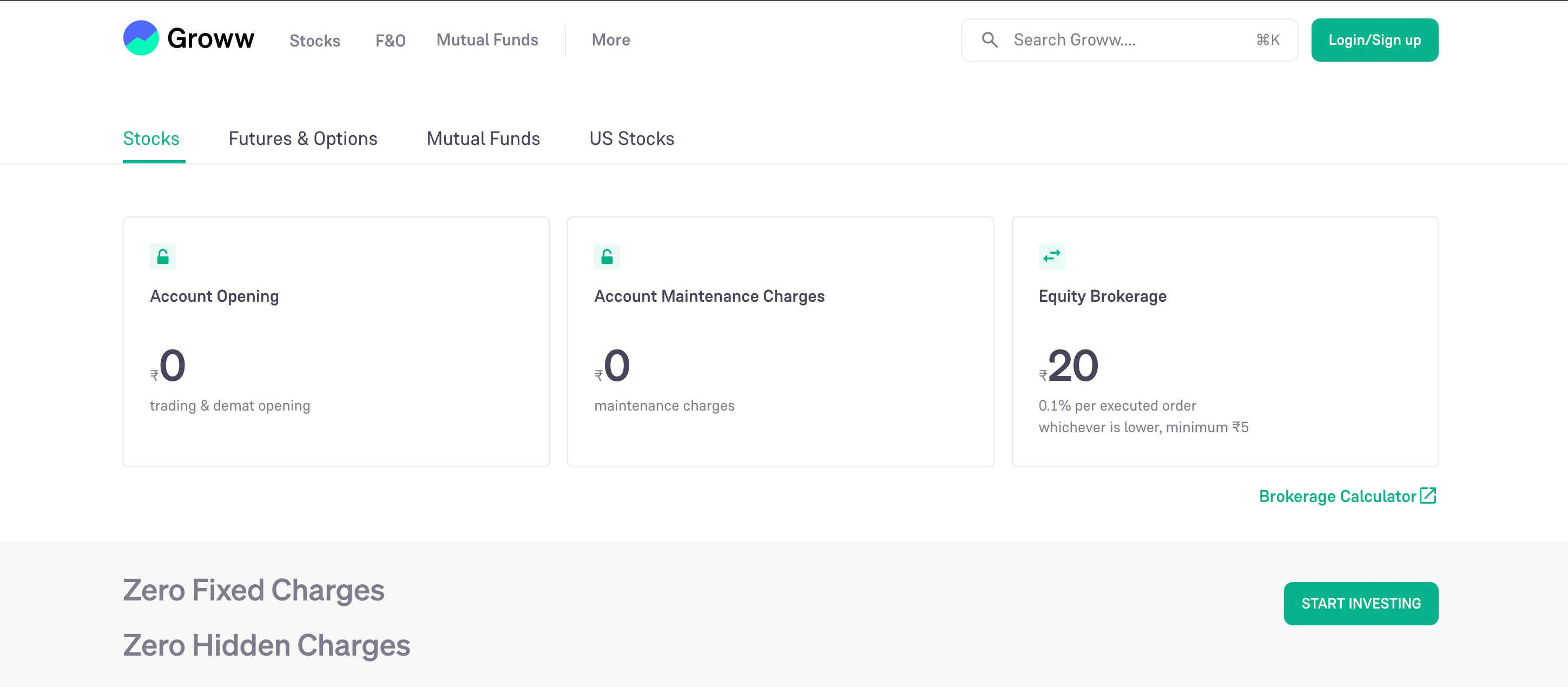
But a buy-and-hold account can make few trades and still owe maintenance. Groww lists ₹0 AMC. Zerodha's first-year waiver and later BSDA or non-BSDA charges depend on account and holdings eligibility. A standard non-BSDA year is ₹354 including GST; eligible BSDA slabs can be lower. Check Zerodha's conditions ↗
If you rarely transact, test the annual total below before assuming zero brokerage wins.02 / ACTIVE TRADER
Use order size and workflow.
For standard equity intraday, Zerodha lists the lower of ₹20 or 0.03% per executed order; Groww lists the lower of ₹20 or 0.1%, with a minimum. Both reach the ₹20 cap on larger orders. Intraday has no delivery-sale DP debit in the model.
At the same ₹2 lakh buy and sell values, our published-fee model returns ₹118.16 at both brokers. That tie is only for this defined trade. Order types, screen layout and support can matter more to a trader. Check each broker's current product documentation against your own workflow.
If your orders are small, change the values in the live estimate; the percentage rates may separate the totals.
One ₹50,000 NSE equity delivery buy and one ₹50,000 sale of the same share. Even with zero delivery brokerage, Zerodha's modeled total is ₹126.58 because statutory, exchange, GST and DP charges remain. Groww's modeled total is ₹182.04 under its standard published tariff.
The ₹55.46 gap in this example consists of ₹40.00 brokerage, ₹7.20 additional GST and ₹8.26 additional DP charge. STT, stamp duty, SEBI and the combined NSE exchange/IPFT fee are the same in this matched scenario.
Illustrative fee estimate, not a contract note. Standard male first-holder DP fee; no AMC, funding, MTF, slippage, gains tax or price movement. STT rounds to rupees; other calculated fee lines round to paise.
ONE MATCHED BUY + SELL₹50,000 each side
Zerodha₹126.58
₹0 brokerage · ₹126.58 other charges
Groww₹182.04
₹40.00 brokerage · ₹142.04 other charges
MODELED DIFFERENCE₹55.46
PUBLISHED PRODUCT FACTS
The apps are more than their tariffs.
Both publish access to stocks, derivatives, mutual funds and IPOs. What differs visibly in their own documentation is how those products are organized and which trading tools they emphasize. A feature list cannot tell us which interface you will find easier.
Zerodha's published setup
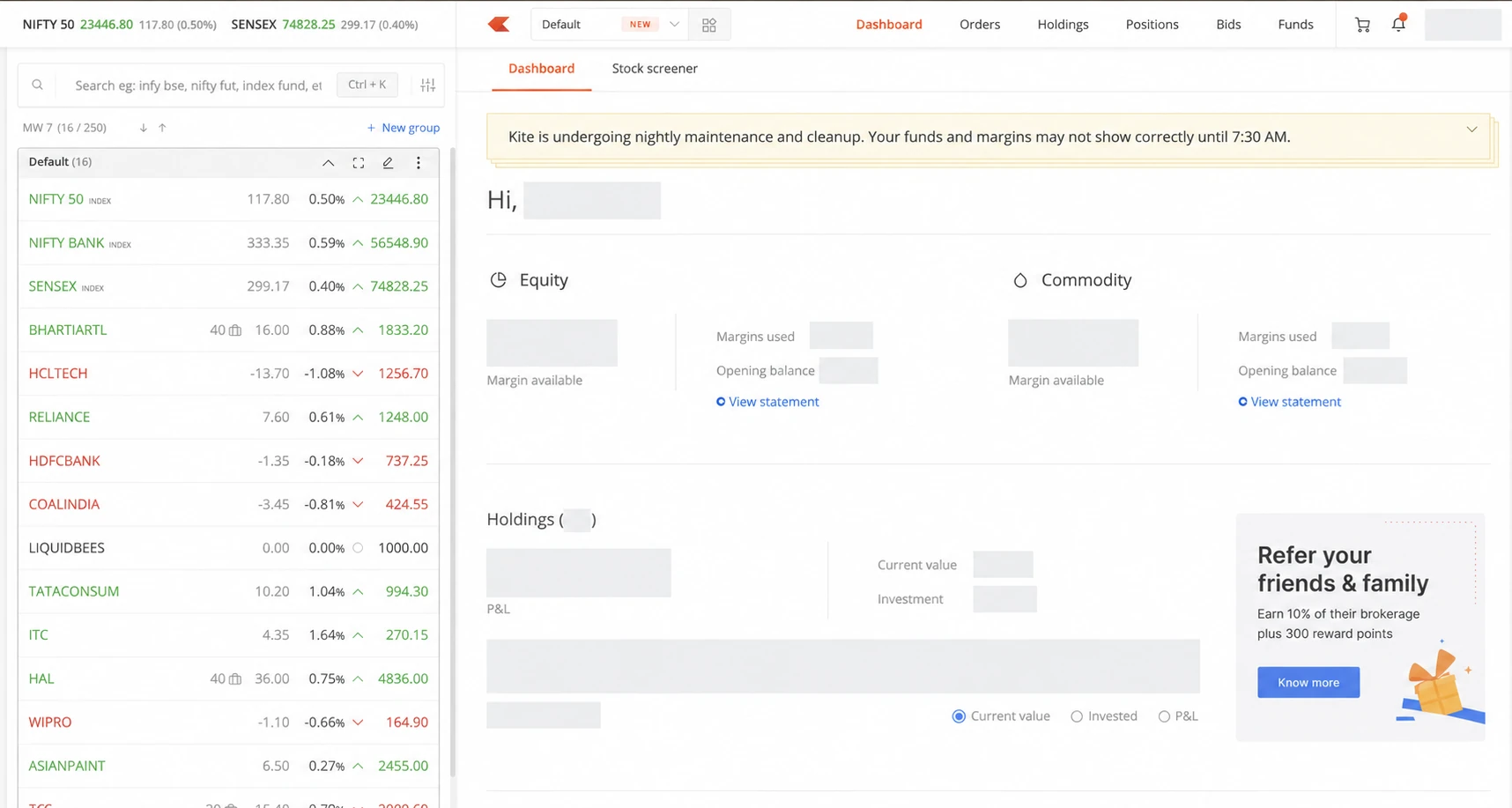
Kite covers trading, charts, baskets, GTT orders and alerts; Console covers account reporting; Coin holds direct mutual funds in demat form. Zerodha lists a free Personal API tier and a paid Connect tier.
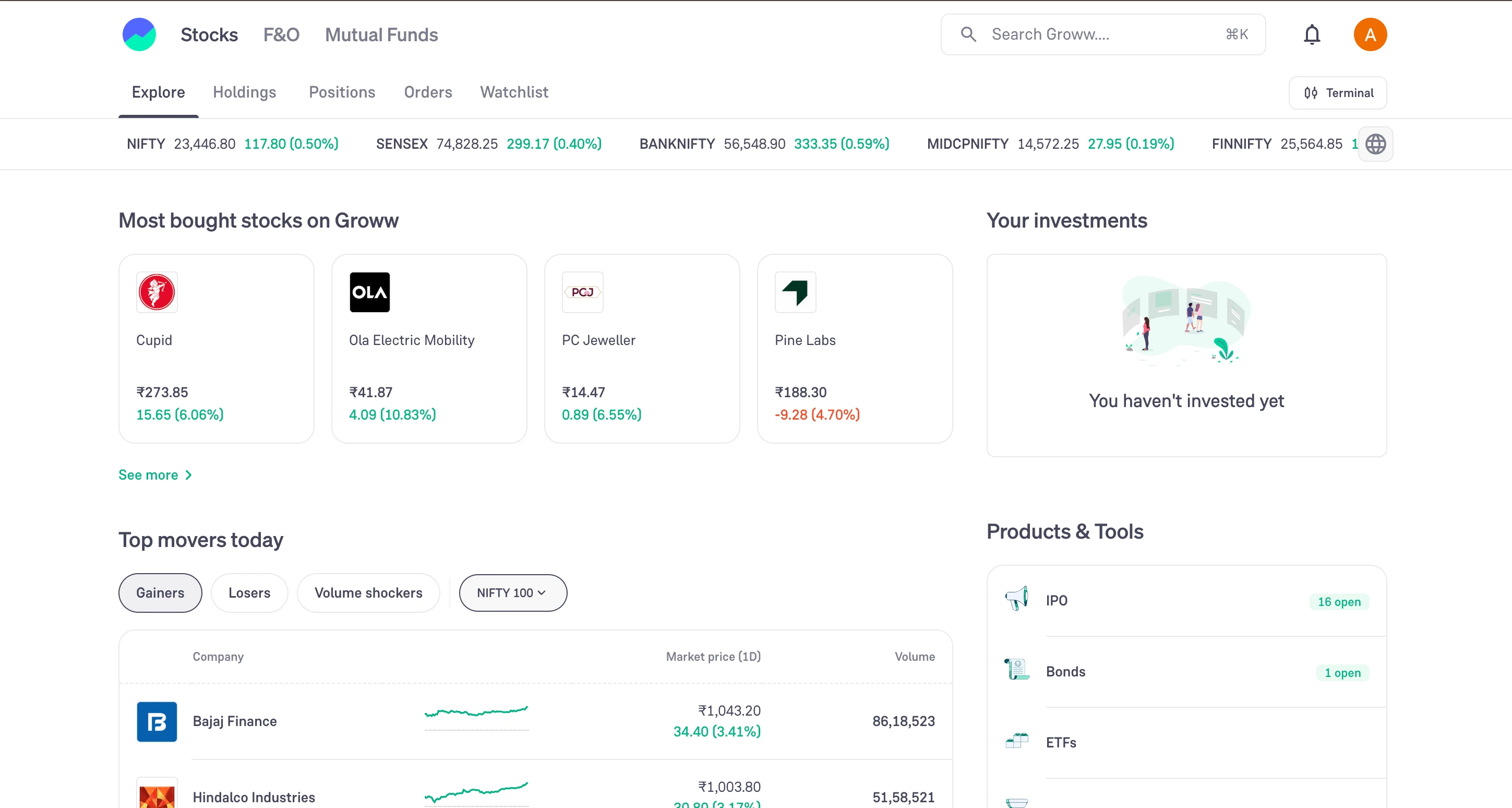
Groww lists stocks, mutual funds, ETFs, IPOs and F&O among its offerings. Its support pages document stock GTT orders; its trade API page lists order, portfolio and market-data access on a paid monthly plan.
Zerodha KiteOwner-provided account view; personal details and portfolio figures obscured. Interface shown for layout comparison. Open full screenshot ↗
Groww dashboardOwner-provided account view showing the Explore screen. Interface shown for layout comparison. Open full screenshot ↗
Before you open or move an account
List the instruments and order types you actually use, then confirm they exist in the broker's current docs.
Enter a typical delivery or intraday buy-and-sell pair in the calculator below. For split sales, also check how each broker counts DP debits.
Confirm your AMC eligibility and any special balance, MTF, NRI or API plan separately; the standard model does not include them.
Try the public demo or read the current help flow for the task you repeat most.
Why combine NSE exchange and IPFT? NSE changed the split between the two charges in March 2026, but their combined cash-market rate stayed at ₹307 per crore per side. The broker pages show different splits; the model uses the unchanged combined rate. Read the NSE circular ↗
Illustrative estimate for one security, one executed buy order and one executed sell order on NSE, ordinary resident-individual account and standard male first-holder DP tariff. STT rounds to the nearest rupee on each taxable side; other calculated fee lines round to paise. STT calculation ↗ DP debits may appear in the funds ledger rather than the contract note. Excludes AMC, funding, MTF, slippage, capital-gains tax, exceptional order modes and price movement. Checked 30 Sep 2026.
Official terms, with caveatsRESIDENT INDIVIDUAL / STANDARD EQUITY
TERMZERODHAGROWW
Equity delivery brokerageZerodha₹0 per executed orderGrowwLower of ₹20 or 0.1%; minimum applies
Equity intraday brokerageZerodhaLower of ₹20 or 0.03%GrowwLower of ₹20 or 0.1%; minimum applies
The total changes once charges around the trade are counted.
For ordinary equity delivery orders, Zerodha lists zero brokerage while Groww charges brokerage. Other costs still apply, especially on a sale. Demat AMC may matter for some Zerodha accounts and is conditional on account type, age and holding value. The live estimate includes published brokerage, statutory levies, GST and one delivery-sale DP debit. Compare the published product features alongside the fee result.
Correction · 23 Sep 2026: For a Groww delivery sale below ₹100, only Groww’s own DP fee is waived. The ₹3.50 depository fee plus GST still applies. The model and profile now reflect this; the standard ₹50,000 example is unchanged. See the change record ↗
Each example uses one NSE equity buy and one sell of the same security, at the same value on both sides. The totals come from the live model above, so they change with the tariff logic rather than a separate editorial table.
EQUITY DELIVERY / ₹1,000 EACH SIDE
Small delivery trade
Zerodha
₹17.56
Groww
₹37.62
The DP debit is a large share of a small trade's fees.
EQUITY DELIVERY / ₹50,000 EACH SIDE
Larger delivery trade
Zerodha
₹126.58
Groww
₹182.04
Brokerage and the delivery-sale DP debit widen the gap.
EQUITY INTRADAY / ₹2,00,000 EACH SIDE
Higher-value intraday trade
Zerodha
₹118.16
Groww
₹118.16
Both brokers reach the ₹20-per-order brokerage cap; the estimates meet.
Illustrative fees only. Standard resident-individual terms and male first-holder DP charge for delivery; AMC, funding, MTF, slippage and taxes on gains are excluded. A fee tie does not mean the brokers are equivalent on platform, service or product fit.
A DIFFERENT COST QUESTION
What happens over a year?
A single trade leaves out account maintenance. This 12-month illustration combines repeated delivery trades with a selected Zerodha AMC circumstance; Groww lists ₹0 AMC.
Set the assumptions.
Each round trip has one buy and a later delivery sale; the sales fall on different days. Both order values are ₹50,000.
The selection assumes the same AMC eligibility for all four quarters. BSDA requires qualifying holdings and only one demat account as sole or first holder; the first-year waiver has an account-opening date and primary-account condition. Confirm your status with the broker.
MODELED 12-MONTH CHARGESGroww lower in this scenario₹298.54 difference
ZERODHAGROWW
Repeated tradesZerodha₹126.58Groww₹182.04
Demat AMCZerodha₹354.00Groww₹0.00
Illustrative totalZerodha₹480.58Groww₹182.04
At one round trip with standard Zerodha AMC, the annual account charge outweighs its lower modeled trading fees. Increase the trade count or change AMC eligibility to see how the result moves.
This multiplies the existing one-buy/one-sell NSE equity delivery model; it is a fee estimate, not a return forecast or an overall broker recommendation. It assumes standard resident-individual terms, a male first holder, separate-day trades and stable published rates. It omits special account/funding modes, slippage, capital-gains tax and changes in portfolio value. AMC is shown as a full-year amount though Zerodha bills quarterly. Sources checked 30 Sep 2026: Zerodha AMC terms ↗ · Groww pricing ↗.
TURN THE ESTIMATE INTO A DECISION
A lower trade bill can still mean a higher annual bill.
The ₹50,000 delivery example saves ₹55.46 in modeled trade charges at Zerodha. That is a useful comparison of one buy and one sale, but it leaves out account maintenance. Add a full regular non-BSDA Zerodha year of ₹354, keep Groww maintenance at zero, and the lower annual-fee result depends on how often that exact trade pattern repeats.
The fee result changes at 7 identical round trips₹50,000 buy + ₹50,000 sell each time · standard Zerodha AMC · separate sale days
Zerodha including ₹354 AMCGroww including ₹0 AMC
1 round trip in the year
Zerodha₹480.58
Groww₹182.04
6 round trips in the year
Zerodha₹1,113.48
Groww₹1,092.24
7 round trips in the year
Zerodha₹1,240.06
Groww₹1,274.28
12 round trips in the year
Zerodha₹1,872.96
Groww₹2,184.48
This is a break-even illustration of a defined fee pattern. It is not a trading-frequency target. The calculation asks how many times the same per-trade saving offsets the selected maintenance amount: ₹354 divided by ₹55.46. The first whole count above that ratio is 7. At fewer trips, the maintenance addition can outweigh Zerodha’s trading-fee advantage in this scenario.
Change the account circumstance and the crossover changes. With an eligible ₹118 annualized BSDA maintenance schedule, the first whole count is 3 identical trips. With a valid zero-AMC case, there is no maintenance amount to offset; Zerodha has the lower modeled fees from the first of these delivery round trips. At zero trades and zero maintenance at both brokers, the modeled totals are equal. Account eligibility therefore belongs in the calculation before the result is interpreted.
How to use the trade calculator
Enter the value of the executed purchase and the planned or actual sale separately. A ₹50,000 purchase does not automatically imply a ₹50,000 sale. Use delivery for the stated settled-share pattern and intraday for the ordinary same-day model. Review the itemized lines before the total: brokerage, STT, stamp duty, exchange and investor-protection fees, SEBI fees, taxable-fee GST and any delivery debit.
If an input changes the result more than expected, locate the line responsible. For small Groww orders, the minimum can be more important than the headline percentage. For small delivery sales, a fixed DP debit can be a large part of the proceeds. For high-value intraday orders, both brokers can reach their brokerage caps. The total tells you the size of the bill; the breakdown explains why it changed.
The calculator describes one ordinary executed order on each side. A portfolio with several securities, split orders or special settlements needs a different count of relevant events. Likewise, a trade using a funded facility or a special balance does not become an ordinary cash trade because it uses the same stock. Use the DP charging-unit guide for sale patterns and the individual profiles for account and funding exceptions.
How to use the annual view
The annual illustration repeats a fixed ₹50,000 buy-and-sell pattern. Select the Zerodha maintenance circumstance that actually applies, then choose the number of those complete cycles. A person making twelve purchases and no sales has not completed twelve round trips. A person buying several times and selling once has not necessarily completed one identical cycle either. If your activity differs, use the custom cost tool or reconstruct the purchases and disposals separately.
Keep the account status stable only when that is realistic. If a first-year waiver expires partway through the period, a portfolio crosses a BSDA slab or another sole or first-holder demat account changes eligibility, divide the year into the affected periods. Applying a full waiver or one later-year rate to all twelve months can create a misleading result even when each individual tariff number is correct.
Use a workflow check beside the fee check.
A fee difference does not tell you whether a platform suits your daily tasks. Choose a concrete workflow to inspect: locating a holding, finding an executed order, viewing a charge preview or downloading the report needed to reconcile it. The screenshots in this guide help identify the interface. Product documentation and your own account records help establish whether the required task is available and understandable.
Record the fee conclusion and the workflow conclusion separately. For example, “lower modeled fees for my settled-share pattern” is a narrower, more useful statement than “better broker”. If your important task is a particular reporting or order workflow, write that requirement down before comparing screen designs. Attractive visuals do not establish execution reliability, and a low maintenance fee does not establish the total cost of frequent trading.
Keep a decision record you can update.
A useful comparison record needs only the tariff-check date, account classification, order values, sale pattern and the features you actually require. Save the relevant calculations with those assumptions. When a broker changes a rate, you can update the affected line instead of rebuilding the whole decision from a marketing headline or an old screenshot.
The fee sources were rechecked on 30 September 2026. The comparison uses ordinary resident-individual NSE equity terms and the stated male first-holder delivery debit. Maintenance is annualized; trading gains, losses, capital-gains tax, slippage and special funding modes remain outside the estimate. These boundaries define what the numbers answer. For the account detail behind a result, read the expanded Zerodha profile or Groww profile.