Zerodha’s tariff separately states 0.5% delivery and MTF brokerage per executed order, and 0.05% intraday brokerage, for this mode. The ordinary ₹0-delivery line should not be copied across to it.
Tariff: 3-in-1 mode ↗MarketByCountry / India / Brokers / Zerodha
BROKER RESEARCH / INDIAZerodha: when is the account really free?
A ₹0 delivery-brokerage headline does not tell you the cost of holding an account or selling a stock. Start with your demat eligibility, then read the trade tariff.
In this guide Jump to a section
THE SHORT ANSWER
For a standard resident-individual account, Zerodha publishes ₹0 equity-delivery brokerage. A newly opened primary account gets its first year of demat AMC waived if opened on or after 1 June 2026. After that, AMC depends on whether the account qualifies as a Basic Services Demat Account (BSDA) and the value of its holdings. A delivery sale can also incur a separate DP debit.
SOURCE CHECKED30 Sep
2026Resident-individual terms
2026Resident-individual terms
The first-year waiver is a starting point, not a lifetime promise.
Zerodha says the first-year AMC waiver applies to a primary resident-individual demat account opened from 1 June 2026. It does not extend to a secondary demat account. After the waiver, the relevant question is whether your account qualifies for BSDA status. Zerodha bills AMC quarterly, so the yearly amounts below are annualized equivalents, including 18% GST where charged. Read Zerodha’s AMC explanation ↗
RESIDENT-INDIVIDUAL ACCOUNT CASEANNUALIZED AMC
New primary account
₹0Opened on or after 1 June 2026, during its first year.
BSDA · holdings up to ₹4 lakh
₹0After any first-year waiver; BSDA eligibility must still be met.
BSDA · above ₹4 lakh, up to ₹10 lakh
₹118₹25 plus GST each quarter.
Non-BSDA
₹354₹75 plus GST each quarter, regardless of holdings value.
A holdings value above ₹10 lakh does not qualify for BSDA. The account-count test concerns demat accounts where you are the sole or first holder. Zerodha’s primary-and-secondary-account example applies regular AMC to both even when each has small holdings. Do not infer “₹0 AMC” from portfolio value alone. Follow the BSDA eligibility path ↗
CHECK BEFORE YOU CHOOSE
Three questions for your own account
- Is this a resident-individual primary demat account, and when was it opened?
- Does it actually qualify as BSDA, including the single-demat-account requirement?
- What is the current value of the holdings used for the BSDA slab?
₹0 brokerage is one line of a trade.
Under Zerodha’s ordinary retail-individual equity tariff, buying and selling delivery shares has no brokerage. The same tariff lists securities transaction tax, stamp duty, exchange transaction and SEBI charges, plus GST on taxable fees. On a delivery sale, Zerodha also lists a ₹15.34 DP debit per scrip for its standard case. A first-holder discount or a different security type can change that debit. Read the full tariff ↗
BUY DELIVERY₹0
brokerage; statutory and exchange charges remain
HOLDAMC
depends on waiver and BSDA eligibility
SELL DELIVERY₹0 + DP
brokerage stays zero; DP debit and other charges apply
For active equity intraday orders, Zerodha lists brokerage at the lower of 0.03% or ₹20 per executed order. This is a different schedule from delivery investing. Our Zerodha–Groww decision guide itemizes one NSE buy-and-sell scenario, while the DP-charge guide explains why sell-order patterns can matter.
Check the account mode before applying the headline.
The tariff gives separate account-opening, AMC and brokerage terms for these categories. This page’s AMC map and ordinary ₹0-delivery framing are scoped to resident-individual accounts.
Tariff: account categories ↗MTF has a separate published interest and brokerage schedule. Zerodha also lists an additional ₹20 per executed order for accounts with a debit balance. These do not belong in an ordinary cash-delivery estimate.
Tariff: additional charges ↗A ₹50,000 trade, with every cost visible.
Start with one ordinary NSE equity-delivery purchase of ₹50,000 and a later sale of the same stock for ₹50,000. The unchanged sale value isolates the charges from any investment gain or loss. Use a resident-individual cash account, one executed order on each side and the standard male first-holder DP rate. The model estimates ₹126.58 in combined charges, even though delivery brokerage is zero.
- Securities transaction tax
- ₹100.00
- DP debit, including GST
- ₹15.34
- Buy-side stamp duty
- ₹7.50
- Exchange, IPFT, SEBI & their GST
- ₹3.74
- Delivery brokerage
- ₹0.00
- Total modeled charges
- ₹126.58
The largest block is transaction tax, rather than a payment for the broker’s service. This matters when evaluating a “zero brokerage” claim: a broker can waive its own delivery commission while other lines still apply. The chart groups exchange charges, the investor-protection contribution, SEBI turnover fees and their GST to keep the visual readable. It keeps the DP debit separate because that fee belongs to the movement out of the demat account.
The estimate rounds displayed fees to paise and STT to rupees. It combines the NSE exchange and IPFT rate following the exchange’s March 2026 circular. A real contract note can differ at the rounding boundary, especially when several executions or securities are combined. Zerodha’s tariff also specifies a minimum ₹0.01 per delivery contract note, which is not added to this model. Use the example to understand the cost structure, then reconcile the actual documents. NSE fee circular ↗ Zerodha tariff ↗
What changes when the sale is smaller?
A fixed demat debit takes a larger share of a small disposal. A ₹15.34 debit is approximately 1.53% of a ₹1,000 sale, but approximately 0.031% of a ₹50,000 sale. Those percentages describe the DP component alone; they exclude the original purchase and every other trade charge. This is why a list of small leftover holdings can produce a bill that looks unexpectedly large relative to the proceeds.
Quantity is not the right counting unit for this question. For ordinary settled shares, Zerodha’s support example charges once for the same stock sold repeatedly on a day, and separately for different stocks. Special settlement situations can create additional debits. Before estimating a portfolio clear-out, group planned disposals by security and day, then apply the rule to each group. The four-broker DP guide illustrates how other brokers can use a different unit. Zerodha’s DP examples ↗
That does not mean changing an investment decision to save a small administrative fee. Price movements and execution needs may outweigh it. The practical benefit of grouping the records is a more accurate budget and a clearer explanation of the eventual ledger, not a recommendation to hold or sell a particular security.
The same trades can produce three annual totals.
Now suppose the investor completes four of those ₹50,000 buy-and-sell cycles in a year. Every cycle uses the same assumptions, with a separate ordinary stock-day sale. The modeled trade charges total ₹506.32. That part is unchanged across the three accounts below; what changes is the published maintenance schedule after any first-year waiver.
Trade chargesMaintenance including GST
Eligible BSDA · up to ₹4 lakh₹506.32₹506.32 trades + ₹0.00 AMC
Eligible BSDA · above ₹4 lakh to ₹10 lakh₹624.32₹506.32 trades + ₹118.00 AMC
Regular non-BSDA account₹860.32₹506.32 trades + ₹354.00 AMC
The blue bar is identical in every row. The amber addition explains the difference without pretending that the broker changed its delivery brokerage. This separates two useful questions: “What do my orders cost?” and “What does this particular account cost to keep?” A low-frequency investor needs both answers. An active investor also needs both, but the account fee may form a smaller part of a much larger annual trade bill.
This is an annualized comparison, not a prediction of four ledger deductions on particular calendar dates. If holdings cross a slab, the account classification changes, a waiver starts or ends, or transactions happen under a special mode, rebuild the calculation for the affected period. Avoid applying the end-of-year portfolio value backwards to every earlier quarter.
Buying without selling is a different pattern.
If you only buy during the period, remove the assumed delivery-sale debits rather than multiplying a round-trip total by the number of purchases. Buying and selling are different events. Likewise, if you simply hold an existing portfolio without transacting, the trade component of this example disappears; the applicable account-maintenance charge remains the question to check. A round-trip calculator is useful only when a round trip actually describes the planned activity.
Write a simple annual inventory before comparing brokers: account status, purchase orders, sale days by security, intraday orders and optional paid services. Keep investment gains and losses outside the fee subtotal. Otherwise a profitable portfolio may hide expensive operations, while a losing portfolio can make a fairly small fee look like the reason for the loss. Our broker-cost tool lets you change order values and the annual activity assumptions.
Kite shows the activity. Reports explain the bill.
A cost guide becomes more useful when you know where to check the numbers. Zerodha’s product map separates Kite for trading, Console for account reports and Coin for direct mutual funds. Think of those as different tasks rather than three interchangeable dashboards. Finding a balance on a trading screen is not the same as identifying the transactions that changed it. Official product map ↗
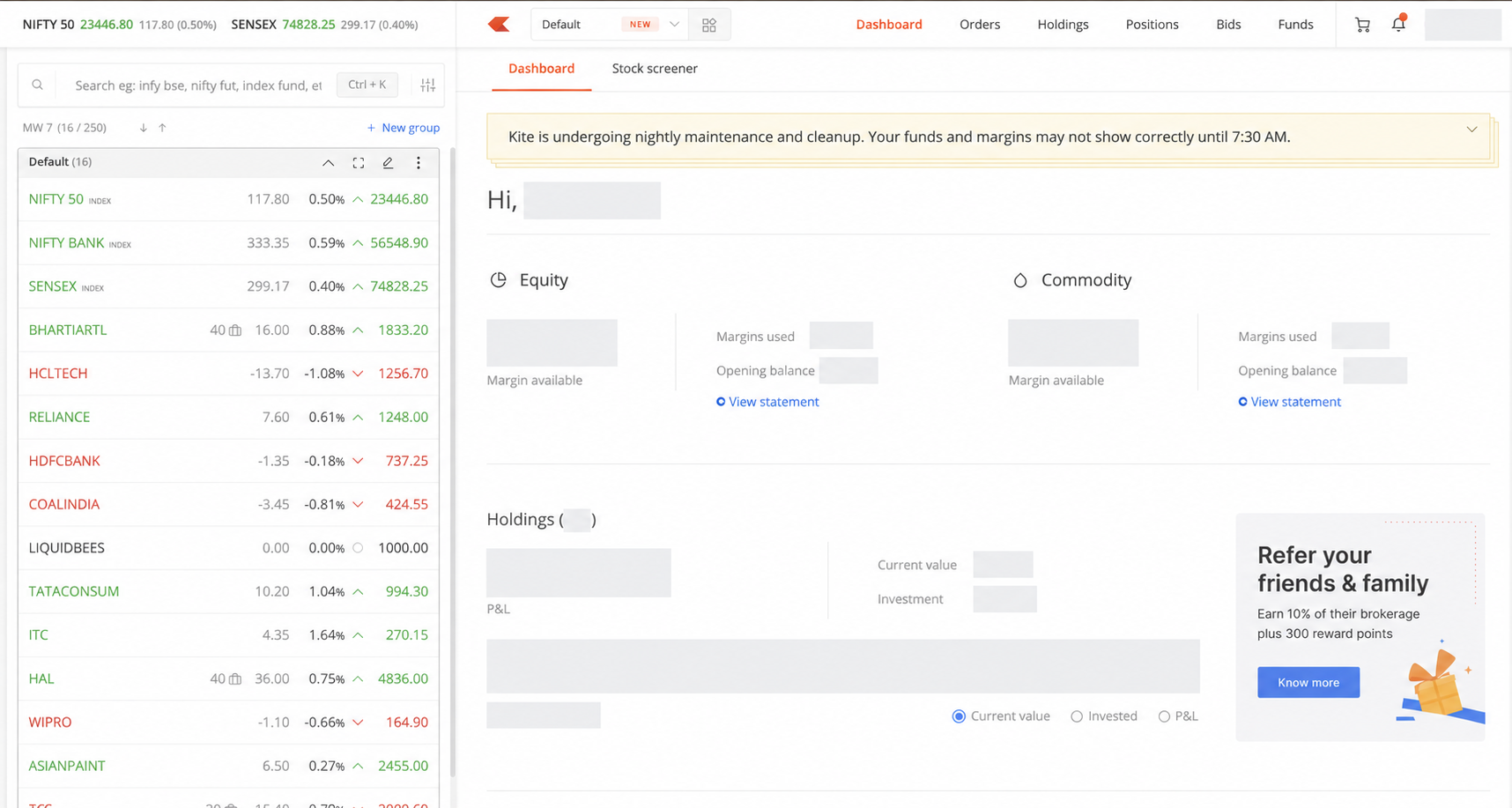
Kite
Start with the security, order and date you want to examine. The screenshot shows a watchlist beside the account dashboard; market prices and account figures are different kinds of information.
Funds statement
Follow the statement path to understand debits and credits. An account balance is a result; the entries explain how it was reached.
Contract note
Match executed trades and their trading charges. Keep the account-level and demat entries alongside it when reconstructing a complete cost.
Read the screenshot as a navigation example. Its historical market quotes are not current prices, and its maintenance banner describes the moment when it was captured. A still image is helpful for recognising a screen; it cannot establish how reliably an order will execute at another time. For your decision, use the screen layout to identify the workflow you need, and use dated account documents for financial reconciliation.
Downloading a usable statement
Zerodha’s support instructions direct web users to Console, then Funds and Statement. Select the category and date range before viewing or exporting the record. On the Kite app, the route starts from the user-ID menu, then Funds and View statement. XLSX or CSV exports make it easier to total a period and filter repeated descriptions. Official statement instructions ↗
Choose a range that covers both the transaction and any later posting you are investigating. Save the original export before editing it, and work on a copy. If you combine several downloads, check for overlapping dates before summing them: duplicated entries can look like duplicated fees. Keep the original descriptions intact so a question sent to support can point to the exact row rather than a renamed spreadsheet category.
Contract notes are a separate download, documented in Zerodha’s report instructions. Keep the note and the funds statement for the same period in one folder. This small habit turns an unexplained debit into a checkable question: which trade happened, which fee was charged, where it was recorded and which published rule should explain it? Contract-note download guide ↗
Reconcile the event before challenging the amount.
An unexpected deduction is easier to investigate when it has a category. Begin with the description, posting date and amount in the funds statement. Then ask what event could produce it: a trade, a demat sale, a maintenance period or an optional service. Do not assume that every debit on a trading account is brokerage. That assumption sends the investigation to the wrong tariff line.
- Identify the account. Note the resident status, account category, primary or secondary designation and applicable trading mode. Your Client Master Report includes the BSDA flag. This is stronger evidence than guessing the classification from a small portfolio balance. Where to find the BSDA flag ↗
- Match the trade. Record the security, exchange, segment, executed buy and sell values and date. Compare those with the contract note, rather than an unexecuted order or a market quote.
- Find the separate demat debit. Zerodha explains that DP charges sit in the funds statement rather than the contract note. Check the relevant security and sale day before counting repeated orders as repeated DP debits. Why the contract note is not the whole bill ↗
- Reconcile maintenance separately. Match the billed period and account classification. An AMC entry does not become an order fee just because it appears near a trade in the statement.
- Ask a precise question if the difference remains. Include the dates, entry description, expected fee rule and calculated difference. Share sensitive account documents through the broker’s authenticated support channel rather than a public comment.
Two common reconciliation mistakes
The first is counting a charge twice. If a trade settlement entry already incorporates a fee, adding that fee again from the contract note can overstate the cash outflow. Trace what each record represents before summing columns. A useful worksheet has a separate column for “included in settlement” and “separate debit”, so each charge contributes only once to the final total.
The second is comparing unlike periods. A single sale’s proceeds are not a sensible denominator for a quarter’s maintenance charge. A monthly trade summary is not a full financial-year account statement. Choose the decision you are checking first, then give every number the same period and scope. The original records should remain available beside the worksheet so the calculation can be retraced.
Decide with your pattern, not the largest headline.
For a delivery investor, the useful feature of the ordinary Zerodha schedule is that its own brokerage does not rise with each delivery order. Whether that produces a low annual bill still depends on maintenance eligibility, sale events and the rest of the trade charges. For an intraday trader, replace that delivery assumption with the applicable per-order calculation. For a funded or special account mode, start from that mode’s terms.
Use three passes. First establish the account you would actually operate. Next model a realistic month or year, including the quiet months. Finally check that you can find the required reports and understand the workflow. The result should be a short set of reasons tied to your activity, not a universal ranking. A different order size, a second account or a different sale pattern can change those reasons.
If you are comparing with Groww, take your completed assumptions into the interactive comparison. If the unanswered question is maintenance across several brokers, use the demat AMC guide. If it is the number of sale debits, use the DP guide. Each route answers a different question; you do not need to reopen every guide to understand a single ledger entry.
THE SOURCE RECORD
Follow each number to its source.
Tariff, AMC, BSDA, DP and report-access sources checked 30 September 2026. Worked figures use the site’s shared NSE equity cost model. Refresh this profile when those schedules, account eligibility or report workflows change.
Correction, 30 September 2026: clarified that the BSDA account-count test concerns sole or first-holder accounts, and that the charged middle slab starts above ₹4 lakh.
Publisher: Ashutosh KhulbeResearch methodDisclosures and corrections
Source-check dates refer to the cited documents and the scope described in each guide.