What are DP charges?
DP stands for depository participant. A DP charge is a fee associated with shares being debited from your demat account when you sell a delivery holding. It is separate from the brokerage for executing the order.
The fee can include both a depository component and the broker’s DP component, with GST added. It is not a charge for every individual share: the applicable tariff and what the broker counts as one charge determine the amount. Zerodha’s DP explanation ↗
For example, Zerodha’s ordinary male first-holder rate is ₹13 plus GST, or ₹15.34. Selling more shares of the same company in one counted stock-day does not multiply that fixed fee by the share quantity. A second stock or a special settlement can change the count. The examples below keep the account and sale assumptions visible.
When do DP charges apply?
Shares leave demat
The ordinary delivery-sale DP fee applies. Check the broker’s rate and whether it counts a stock-day, sell order or transaction.
Shares come in
The ordinary sale-side DP fee is not charged on a delivery purchase. Brokerage and other trade charges are separate questions.
No delivery holding sold
An ordinary intraday trade does not attract this delivery-sale DP fee. A trade converted to delivery needs to be assessed under the delivery terms.
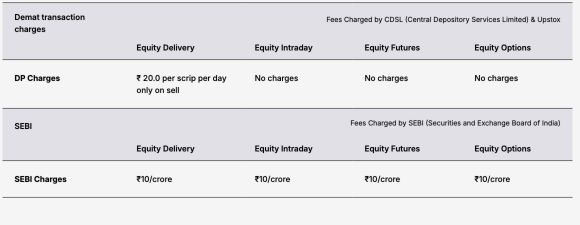
Angel One distinguishes delivery sales from delivery buys and intraday trades; Upstox also lists no DP fee for intraday and F&O. Other depository services, such as pledging or off-market transfers, have their own tariff lines. Do not apply the equity-sale rate to every account movement. Angel One applicability ↗ · Upstox tariff ↗
DP charges, brokerage and AMC are different fees.
- Brokerage
- The broker’s charge for executing a trade. A zero-brokerage delivery order can still have a separate DP fee on sale.
- DP charge
- The fee tied to a counted debit from demat on a delivery sale. Check both the rate and the counting rule.
- Demat AMC
- The charge for maintaining the account under its applicable schedule. Read the demat AMC and BSDA guide for this separate account cost.
To check a bill, first identify which fee you are looking at. A DP fee may be posted separately from the trading contract note: Zerodha, for example, records it in the funds statement. Zerodha billing detail ↗
This guide compares four published rules. It is a focused sample of India's broker market, not a claim that these are the only brokers or that every account uses the same tariff. All amounts below include 18% GST and use the ordinary male first-holder tariff where a gender-based depository component applies.
For one stock sold once, the standard DP amount is ₹15.34 at Zerodha and ₹23.60 at the other three brokers shown here. Split that same stock into two separate sell orders on one day and the modeled DP total stays ₹15.34 at Zerodha and ₹23.60 at Upstox, but rises to ₹47.20 at Groww and Angel One. Other trade costs may change the overall comparison.
Two counting rules, four brokers.
Zerodha and Upstox describe the unit as a stock (or scrip) sold on a day. Groww describes an order-level charge, while Angel One's published example counts each transaction. The distinction matters most if you sell one holding in more than one order.
One stock, one day
Multiple ordinary sales of the same stock on one day usually share one debit. A second stock adds another.
Read published rule ↗One scrip, one day
Its tariff says ₹20 plus GST per scrip per day on a delivery sell.
Read published rule ↗Each sell order
Two separate orders for the same stock can each attract a debit. This figure assumes each sale value is at least ₹100.
Read published rule ↗Each transaction
Its support example charges twice when the same stock is sold in two transactions on one day.
Read published rule ↗The displayed prices are per counted unit, not per share. Zerodha publishes ₹13 plus GST; the other three publish ₹20 plus GST for the standard case used here. Broker terms can change, so the linked tariff matters more than a search-result snippet.
The cost of another sell order
DP charges only, including GST
Number of separate sell orders →
View the exact chart values
| Orders | Zerodha | Upstox | Groww | Angel One |
|---|---|---|---|---|
| 1 | ₹15.34 | ₹23.60 | ₹23.60 | ₹23.60 |
| 2 | ₹15.34 | ₹23.60 | ₹47.20 | ₹47.20 |
| 3 | ₹15.34 | ₹23.60 | ₹70.80 | ₹70.80 |
| 4 | ₹15.34 | ₹23.60 | ₹94.40 | ₹94.40 |
Try your sale pattern.
Enter the orders you might place to see which ones share a stock-day debit and which ones count separately. The figures update as you change the rows.
How many DP debits?
Each row is a separate equity-delivery sell order. Change the stock, day or sale value to see how each published counting rule applies.
Ordinary resident-individual, male first-holder tariffs shown. Groww's lower DP charge applies to a sell order below ₹100. Separate settlements and other trade costs are outside this estimate.
What changes when you split a sale?
Suppose you sell Stock A for ₹5,000 at 10:00 and another ₹5,000 at 14:00 on the same ordinary trading day. The diagram counts DP debits only; it does not model brokerage, taxes, price changes or order execution.
The gap here is not proof that one broker is cheaper overall. A change in brokerage or execution price could outweigh this DP difference. It shows why a flat “DP charge” number is incomplete without its counting unit.
Four sale patterns to check.
Every order in these examples is a ₹5,000 equity delivery sale. The first three patterns happen on one ordinary trading day; the fourth spans two days. Each amount is a DP-only total including GST.
Stock A · one ₹5,000 sell order
One demat debit at every broker.
Stock A · two ₹5,000 sell orders on the same day
Day-based rules count once; order or transaction rules count twice.
Stock A and Stock B · one ₹5,000 sell order each
Each stock has a separate demat debit.
Stock A · one ₹5,000 sell order on each of two trading days
A new day starts a new charge even for the same stock.
On a single ₹500 sale, a ₹15.34 DP fee alone equals 3.07% of the sale value; ₹23.60 equals 4.72%. That is one reason to inspect the complete cost of very small sales. It is not a reason to hold a position longer or combine orders at the expense of price or execution risk.
Follow a sale from order to fee.
The word debit is easy to misread as a deduction from the cash you receive for a sale. In this guide it first means shares leaving a demat account. A DP charge is a separate fee associated with that movement. It is not a percentage of the stock price and it does not rise simply because you sold more shares in one counted unit. The Zerodha explanation and Angel One explanation both distinguish the fee from the number of shares sold.
The third step is the one people tend to skip. Seeing two executed orders does not automatically mean two DP fees at every broker. Nor does seeing one stock name guarantee only one fee. Zerodha explicitly groups ordinary same-stock sales made on a day, while Groww explicitly counts separate sell orders. Upstox quotes a per-scrip-per-day price, and Angel One quotes a per-scrip-per-transaction price. These are published billing rules; the diagram is a way to apply them, not a claim that we inspected a private depository ledger.
Think of a sale log with three columns: stock, trading day and order or transaction. Zerodha's ordinary case asks how many distinct stock-and-day pairs are present. Upstox uses the same published unit. Groww asks how many separate sell orders are present. Angel One's published wording and same-stock example point to transactions. The calculator above makes these counts visible, but a real bill can also reflect account-specific terms or an exception. That is why the result is a model of a stated rule rather than a prediction of every ledger entry.
What sits inside a ₹15.34 or ₹23.60 fee?
The standard amount shown in a pricing table combines more than one party's charge. Zerodha publishes ₹9.50 as its component and ₹3.50 as the CDSL component for a male primary holder. Their ₹13 subtotal attracts 18% GST of ₹2.34, producing ₹15.34. Groww publishes ₹16.50 as its component and ₹3.50 as the depository component for the corresponding sale. The ₹20 subtotal attracts ₹3.60 GST, producing ₹23.60. Those components come from the brokers' own Zerodha and Groww explanations.
Upstox publishes a ₹20 per-scrip-per-day DP price for delivery sells; Angel One publishes ₹20 per scrip per transaction. Adding 18% GST gives ₹23.60 in the standard examples on this page. Their identical example totals do not mean their counting rules are identical. It would be equally misleading to call either figure “₹20 per sale” without saying what the broker counts as a sale unit. The fee column tells you the rate; the charging-unit column tells you how many times to use it.
Also keep this component breakdown separate from brokerage. A broker may charge brokerage for executing a delivery order and a DP fee when shares leave demat. Calling the DP component “broker charges” in a support article does not turn it into trading brokerage. A headline saying “zero delivery brokerage” therefore cannot establish that selling a holding has zero total cost. If you want to compare two brokers, calculate brokerage, statutory levies and DP fees for the same buy-and-sell pattern. Our worked Zerodha–Groww comparison does that for a specific scenario.
Three situations the simple fee table hides.
Several shares of one company in one order
Imagine selling 5 shares of Stock A in one order, then consider selling 500 shares of the same stock in one order. Under each broker's ordinary published DP unit, both are one counted sale unit. The rupee fee is therefore the same for these two orders if they are otherwise in the same tariff category. The larger sale will have a smaller DP fee as a percentage of proceeds, but this says nothing about market price, brokerage or tax. Groww's order-counting example explicitly says multiple units of one stock in one order incur one DP charge. Angel One says quantity does not drive its DP fee.
Two stocks, even if sold minutes apart
Now sell Stock A at 10:00 and Stock B at 10:05. The difference from splitting Stock A is that there are two distinct securities. Zerodha says different companies sold on a day each attract a charge; Upstox's tariff says “per scrip per day.” Groww's two separate orders also count twice. Angel One's per-scrip-per-transaction wording points to the same count for this ordinary example. The resulting DP totals are ₹30.68 at Zerodha and ₹47.20 at each of the other three brokers, under the standard tariffs used here. Moving the orders five minutes closer together does not merge the two stocks into one charged security.
One holding sold across two trading days
Suppose you sell part of Stock A on Monday and the rest on Tuesday. At the stock-day brokers, these are two stock-day pairs. At an order-based broker, the two orders are already two counted units. The standard example again produces ₹30.68 at Zerodha and ₹47.20 at each of the other three. This does not mean a multi-day sale is a bad decision. The market price may move by far more than the extra DP charge. The example isolates the fee so you can recognise it later, not so you choose a trading day from a tariff table.
A subtly different case is one order filled in several trades. A screen may display multiple executions even though you submitted only one sell order. Do not convert a trade-fill count into an order count without checking the broker's order record. Groww's published answer specifically discusses separate orders; Angel One uses transactions. The sources used here do not settle every partial-fill or special-order case across all four brokers. If your charge turns on that distinction, check the order IDs and ask the broker which fee unit was applied to the actual sale.
How to check a DP charge after you sell.
You can investigate a fee without guessing from a generic calculator or sharing private account details publicly. Start with the broker's executed-order history. Write down the stock or ISIN, the trading date, the order ID and the sell value for each delivery sale. Keep separate stock names on separate lines. If the order history shows several executions under one order ID, keep that fact visible rather than silently treating each fill as another order.
- Classify the trade. Confirm it was a delivery sale from a demat holding. The ordinary DP sale fee is not the same charge as a delivery buy, an intraday square-off or an F&O trade. Upstox and Angel One state these distinctions in their pricing and support pages.
- Count the relevant units. For the standard Zerodha and Upstox examples, count stock-day pairs. For Groww, count separate sell orders. For Angel One, begin with its per-scrip-per-transaction wording and compare with the transaction record. Note any settlement event that may make the ordinary count inapplicable.
- Apply the account tariff. Use the rate for the first holder and the sale size. In particular, Groww's own ₹16.50 component is waived when a sell value is below ₹100, while its depository component still applies. A rate copied from somebody else's account may not fit yours.
- Find the posted fee. Compare the expected amount with the account's funds or charge statement. Zerodha says its DP charge appears in the funds statement, not the contract note. A missing DP line on a Zerodha contract note is therefore not evidence that no fee was charged.
- Investigate a mismatch. First check for another stock, another day, multiple separate orders, an account tariff difference or a special settlement. If those do not explain it, send the broker the relevant order IDs and fee entry. An actual statement is stronger evidence for your bill than our modeled example.
The sequence matters. If you multiply a per-order rate by the number of stocks, or a per-stock-day rate by the number of fills, the arithmetic may be flawless while the answer is wrong. The Zerodha funds-statement explanation is especially useful when your trading document and account balance seem not to reconcile. For other brokers, use their current account reports and support guidance rather than assuming every platform displays DP charges in the same place.
Should a DP fee change how you place orders?
It is tempting to read the split-sale chart and conclude that one larger order is always better. That would use a narrow fee calculation to answer a broader trading question. On Groww, a second ordinary ₹5,000 sell order for the same stock adds a modeled ₹23.60 DP charge; on Angel One the published same-day example also counts another transaction. Yet a different execution price, brokerage charge or order outcome can change the overall result. The DP calculation tells you the fee consequence of a pattern, not which order pattern will execute best.
For scale, a ₹23.60 additional fee spread across a sale of 100 shares is ₹0.236 per share. This is arithmetic, not a target price: ₹23.60 divided by 100. If a change in execution price were ₹0.24 per share on those 100 shares, the price difference alone would be ₹24, already slightly larger than that added DP fee. Conversely, on a tiny sale the fixed fee can be a large share of the proceeds. These examples make the trade-off visible without assuming that combining orders will achieve a particular price or that delaying a sale is prudent.
Compare equal quantities, equal dates and the same intended order pattern before treating the broker totals as a ranking. Then include brokerage, exchange charges, taxes and execution price separately. A lower DP line can coexist with a higher total cost.
This is also why a broker's flat rate should be read alongside its counting unit. One order at Groww and one stock-day at Upstox both show ₹23.60 in our standard case. Split a holding into two orders on one day and those descriptions no longer describe the same thing: the model gives ₹47.20 at Groww and ₹23.60 at Upstox. Change the stock count or the day and the comparison changes again. A useful tariff comparison begins with a realistic sale pattern, rather than deciding from the lowest number printed in a fee table.
What can change the result?
- Groww sales below ₹100: Groww says its own ₹16.50 component is waived for a debit value below ₹100. The ₹3.50 depository component plus GST still comes to ₹4.13 for the male first-holder case. Fee detail ↗
- First-holder tariff: Zerodha lists a lower CDSL component for female first holders, bringing its ordinary charge to ₹15.05. Groww also lists a lower CDSL component for female first holders. Check the tariff attached to the actual demat account. Zerodha detail ↗ Groww detail ↗
- Separate settlements: Zerodha notes that even sales of the same stock can result in separate debits in special settlement circumstances. The “one stock-day” figure here assumes an ordinary settlement. Exception ↗
- Other costs: Brokerage, exchange and statutory charges, account maintenance, funding, slippage and capital-gains tax are outside this comparison. For a fuller worked trade, see the Zerodha–Groww cost comparison.
Check your broker's current tariff and your funds or demat statement for the actual debit. Zerodha says its DP charge may appear in the funds statement rather than the contract note, which can explain an apparent mismatch when reconciling a sale.
Read the rule, not just the fee.
These broker-published lines explain why the same pair of sell orders produces different DP totals. Open the linked pages for the surrounding terms and current tariffs.
The public Upstox pricing page puts its charging unit directly beside the fee: “per scrip per day only on sell.”