How do you close a demat account?
To close a demat account, identify the depository participant, decide what happens to any remaining securities, complete its current closure process and retain the final confirmation. An empty portfolio or an uninstalled app does not establish that the account has closed.
Original process illustration · no account action performed
Start with the outcome you actually want. Perhaps you have stopped investing, want fewer accounts to maintain, or are moving everything to another broker. Those situations can lead to different paperwork. The right request describes the account being closed and, where relevant, the destination of the holdings.
Then obtain the closure confirmation.
Keep both. They answer different questions if a charge, missing holding or delayed request needs investigation.
This guide gives you a preparation method, an explanation of common form fields and adaptable letter wording. It does not turn a generic letter into every DP’s accepted submission method. Use the provider’s official channel and current instructions for your account type.
If your goal is only to move selected securities and keep the existing account, use the share-transfer guide. Here the task is ending the account relationship correctly: choosing its scope, resolving unfinished items and collecting evidence of completion.
Demat, trading or both?
A broker app can bring several services into one screen. That convenient presentation can make a closure request surprisingly ambiguous. Write down the service and account identifier before you select a form option. A demat identifier, a trading user ID and a linked bank account are different records.
Demat account
Identify the DP and complete demat account number.
Trading account
Confirm whether its closure is included or separate.
Linked bank account
Do not assume a demat request closes the bank relationship.
Groww’s published blank closure form makes the distinction visible: it offers Trading, Demat and Both choices. It also has separate identifiers and an acknowledgement section. That is a useful example of why “delete my account” is less precise than naming what you want closed. Inspect Groww’s form ↗.
Use this small scope note for your own records: “I want to close [demat/trading/both], held with [provider], identified by [reference]. I want [other service] to remain available, subject to the provider’s rules.” This is preparation wording, not a promise that every combination is supported.
Check linked products separately. If you also use a mutual-fund service, recurring investment instruction or another product under the same login, ask what the requested closure affects. Avoid solving that uncertainty by selecting the broadest available option. A clear answer before submission is easier to work with than trying to recover access afterwards.
Prepare the records before ending access.
Make a dated snapshot of the account as it stands. Save the holdings statement, relevant transaction statements, account ledger, purchase evidence and any support correspondence about unresolved items. Keep readable filenames rather than a folder full of untitled screenshots. Include the provider, account reference and reporting period.
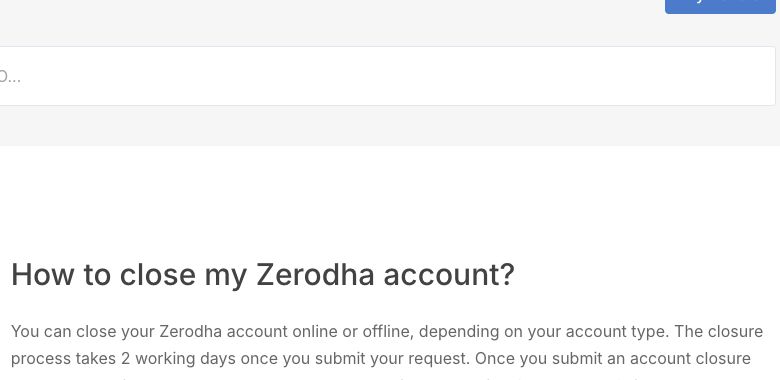
Zerodha specifically tells customers to download reports before closing; its current guidance warns that submitting a closure request removes access to Kite, Console and Coin. Treat that as a reason to prepare first, not a step to postpone until after pressing submit. Zerodha’s closure requirements ↗.
0 of 5 checks complete
Tick the items you have checked. This list does not submit or approve a closure request.
Look at activity as well as the current balance. A pending instruction, expected credit or unresolved debit deserves its own line on your preparation list. Record what it is, who is handling it and which reference identifies it. If the provider says an item blocks closure, ask what event or document will remove the block.
Keep your acquisition history even if the securities have already moved to another account. Closure evidence answers whether the account ended; purchase records answer what you acquired and when. One is not a replacement for the other. Preserve both in a place you can access independently of the broker login.
For a simple household filing system, make three subfolders: “before closure”, “request” and “confirmation”. Put the last statements in the first, the signed application and acknowledgement in the second, and completion messages and reconciled records in the third. This is an organizational suggestion, not a regulatory filing format.
Choose their destination before closing the account.
A wish to close an account is not automatically an instruction to sell everything inside it. If you want to retain the investments elsewhere, ask the existing DP about account shifting or closure-cum-transfer. If you intend to sell, consider that as a separate investment decision with its own execution, settlement and reporting consequences.
CDSL’s shifting requirements include the receiving Client Master Report and matching holder names in the same order. Cross-depository shifting is limited to free balances; do not presume locked or pledged securities can follow that route. CDSL account-closure FAQ ↗. The transfer guide’s closure section explains the distinction without repeating the full transfer workflow here.
For your request pack, use a holdings schedule with one line for each security: name, ISIN, quantity, current status and intended destination. Leave a blank “confirmed outcome” column to fill when the move is complete. A total portfolio value is a poor substitute because prices can change while an instruction is being processed.
Consider a fictional example. Riya wants to leave an old broker but keep two investments. She first obtains her receiving account details and asks which shifting process applies. Her closure checklist remains unfinished until she can reconcile both holdings and obtain the old account’s closure confirmation. Seeing the investments in the new app satisfies only the holdings check.
Online closure is a process, not just an email.
Use the DP’s official help page to find the route for your account category. Avoid treating an old tutorial’s screen names as universal. Your relevant question is whether the provider accepts that method for your account now, including its authentication and document requirements.
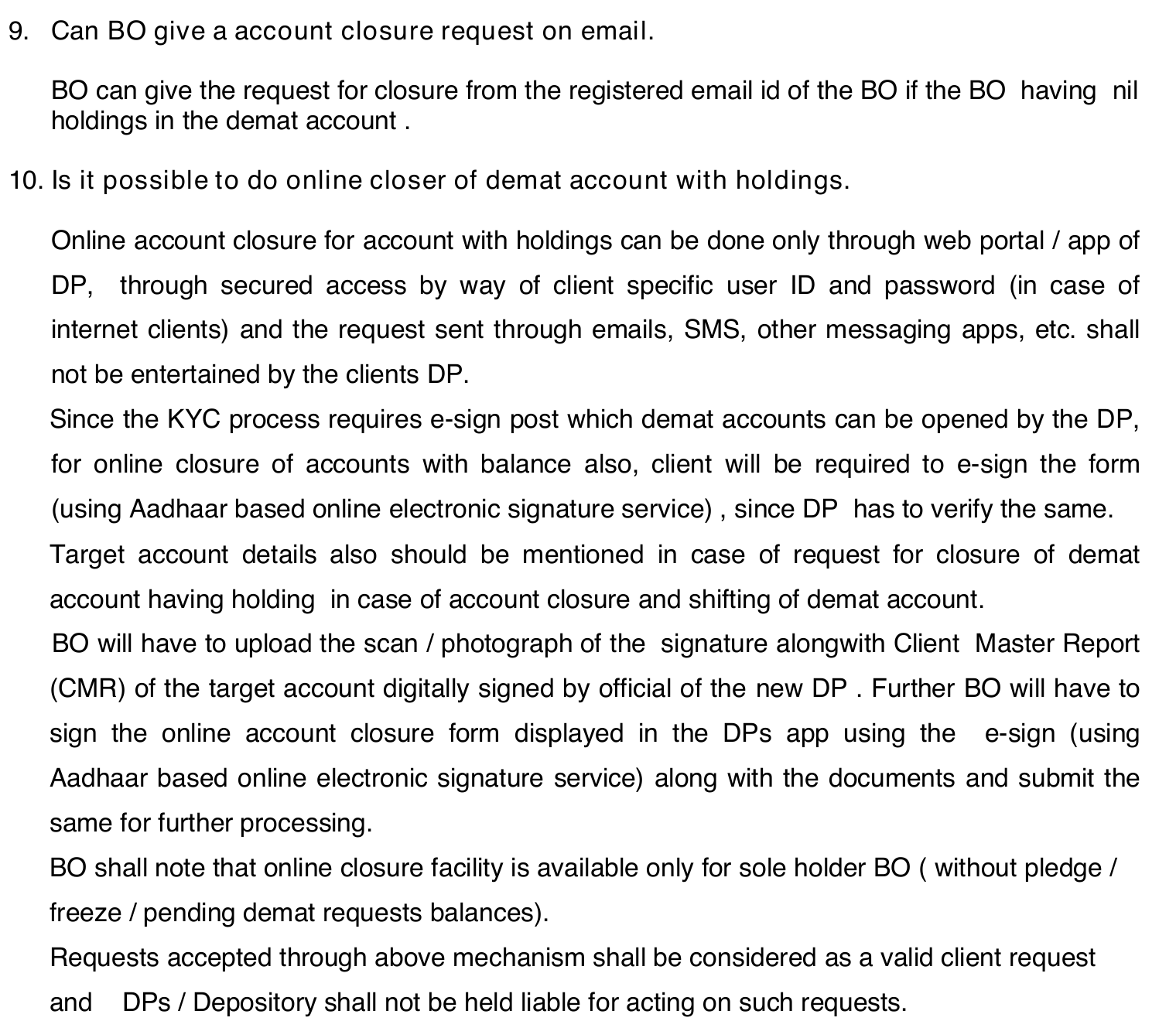
CDSL distinguishes a registered-email request for nil holdings from online closure with holdings, which uses the DP’s secured portal or app and e-sign. Its FAQ also sets eligibility conditions for that online route. A sample email should therefore not promise to close every account on its own. CDSL FAQ, sections 7–10 ↗.
Zerodha: Console → Account → Segments → Account closure
Its guide describes the online route, holdings choices and e-sign. Joint holders and minors without Kite access use a ticket with the signed form; non-individual accounts use its offline process. Recheck the current instructions for your category. Open the official steps ↗.
For paper submission, confirm where the current DP wants the application delivered and whether it accepts a scan, original or electronic signature for that route. Keep a complete copy before sending it. Use the address shown in current official instructions rather than a postal address copied from an old social-media post.
Do not send credentials to someone offering to “finish the closure” for you. An account identifier in a signed request is different from a password, PIN or authentication code. Enter authentication only within the official workflow you initiated, and keep personal documents out of public comments or screenshots.
If an online application fails, record the stage and error. “The e-sign step failed after generating reference [x]” is more useful than “closure is not working”. Before starting again, ask whether the first request exists. Multiple requests with different dates and attachments can make an already unclear case harder to follow.
The form should tell one consistent story.
Read the whole application once before filling it. Locate the account-scope selector, holder details, remaining-balance instructions, signature areas and acknowledgement. Then complete it from your account records. Do not rely on memory for a long account number or the order of joint holders.
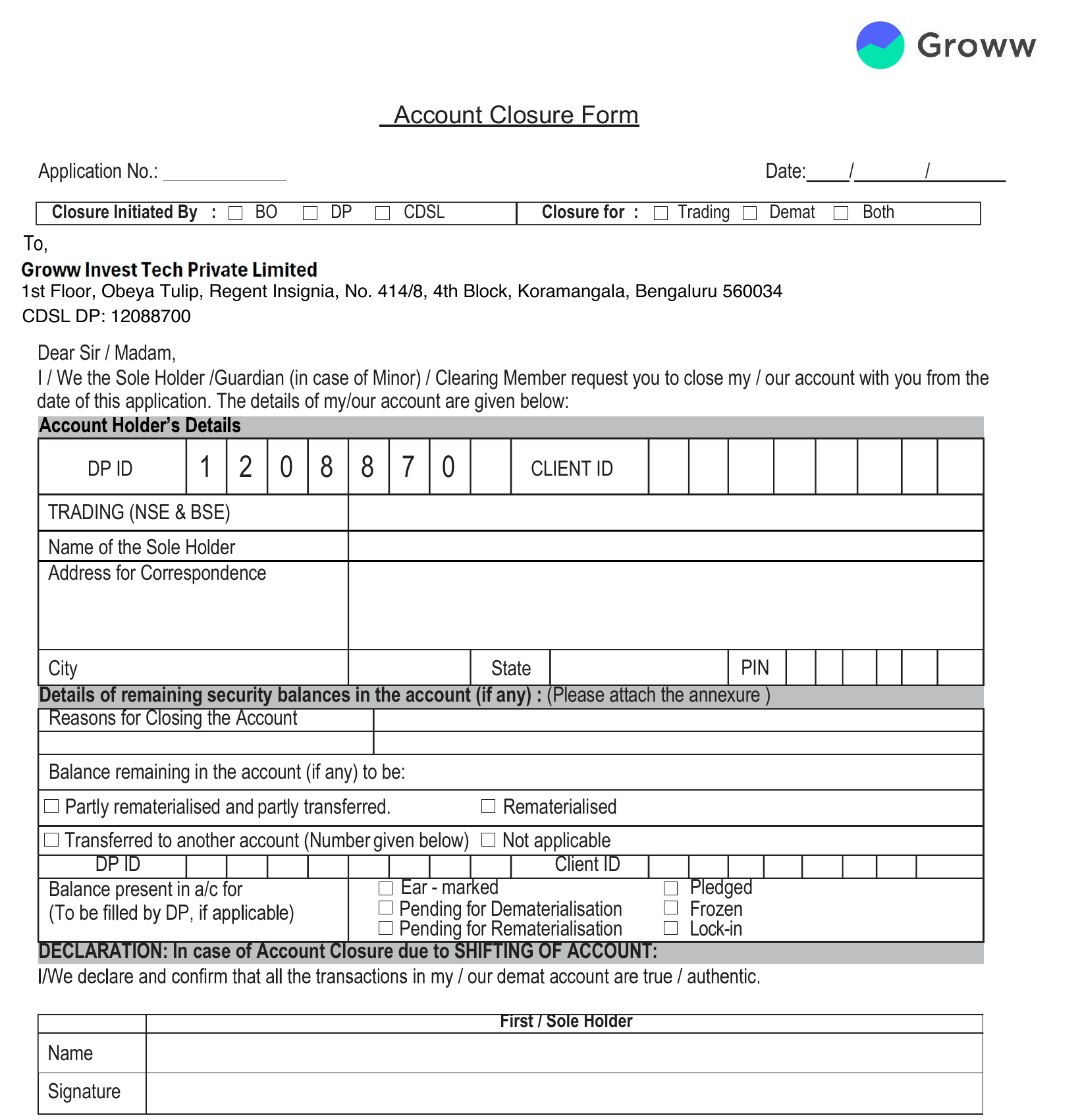
The Groww form asks how remaining securities should be treated and includes a receipt marked subject to verification. Receipt therefore establishes that an instruction was received; it is not the same as a completion certificate. Its fields are a reading example, not permission to submit Groww’s form to another DP. View the official blank PDF ↗.
For a joint account, organize the signature check with the same care as the account-number check. Do not assume the person who normally operates the app can sign for every holder. Confirm the applicable instructions before collecting signatures, especially where a guardian or authorised representative is involved.
Compare the completed application with the attachments. A letter that says there are no holdings should not accompany a schedule that lists securities awaiting transfer. If something changed while you prepared the pack, update both. Consistency helps the recipient understand what you are requesting without having to guess which document is current.
Demat account closing letter format.
Use this original template to organize a written request or covering letter where the DP accepts one. Replace every bracketed field, remove choices that do not apply and use the official form when required. Do not sign a statement about balances or dues unless you have checked it.
Date: [date]
To: [DP name and official department/address]
Subject: Request to close [demat account / specified accounts]
Dear Sir or Madam,
I/We request closure of the following account held with you:
Holder name(s), in recorded order: [names]
Demat account identifier: [complete identifier]
Related trading account, if included: [reference or not applicable]
The requested scope is [demat only / trading only / both, as supported by your process]. Please confirm any separate instruction needed for linked services.
Remaining securities: [nil / to be shifted under the enclosed agreed instructions]. If shifting, the receiving account details and required CMR are enclosed. Please advise if any listed balance requires separate handling.
I/We enclose [list the required documents]. Please identify any outstanding dues or incomplete requirements with the relevant description and period, and acknowledge this request with a reference number.
Once processed, please confirm the closure date, account identifier and final status through my/our registered contact details. Please also provide the final statement and details of any applicable refund.
Yours faithfully,
[Required holder signature(s)]
[Registered contact details, where required]
Sample wording only. This does not submit a request or replace an official form.
Do not turn the template into a list of unsupported declarations. It deliberately asks for any outstanding requirement to be identified rather than asserting that every possible obligation has disappeared. The destination attachment belongs only in a shifting request, not in a genuinely empty-account closure.
CDSL’s FAQ recognizes an account-closure form or holder-signed letter for a written closure request, while account shifting has additional requirements. The method of submitting that request still matters. CDSL written-request guidance ↗. Keep a signed copy and the accompanying document list so you can show exactly what was sent.
Closure fees, existing dues and refunds are different questions.
SEBI abolished demat account-closure charges from 1 November 2002. Its later account-transfer circular provides for no transfer charge when all securities shift between accounts identical in ownership, including the same joint-holder sequence. These rules do not mean an ordinary partial transfer is free or that existing dues vanish. Closure-charge decision ↗ · Account-shifting circular ↗.
Ask for an itemized explanation if you receive a closing debit. Write down its description, service period and tariff basis. A maintenance charge for an earlier period, a transaction entry and a fee described as account closure are not interchangeable. Check the entry you actually received rather than applying a general “free closure” statement to every balance.
There is also a specific prepaid-AMC question. SEBI’s 1 July 2010 circular provides refunds for remaining quarters where annual or half-yearly AMC was collected upfront. It excludes monthly and quarterly collection. The account year starts from opening, in quarterly rests. Read the refund rule and examples ↗.
Closure in the first quarter → three remaining quarters → ₹300 illustrative refund.
Invented fee; assumes the circular’s annual-upfront conditions. Not a broker quote or a GST calculation.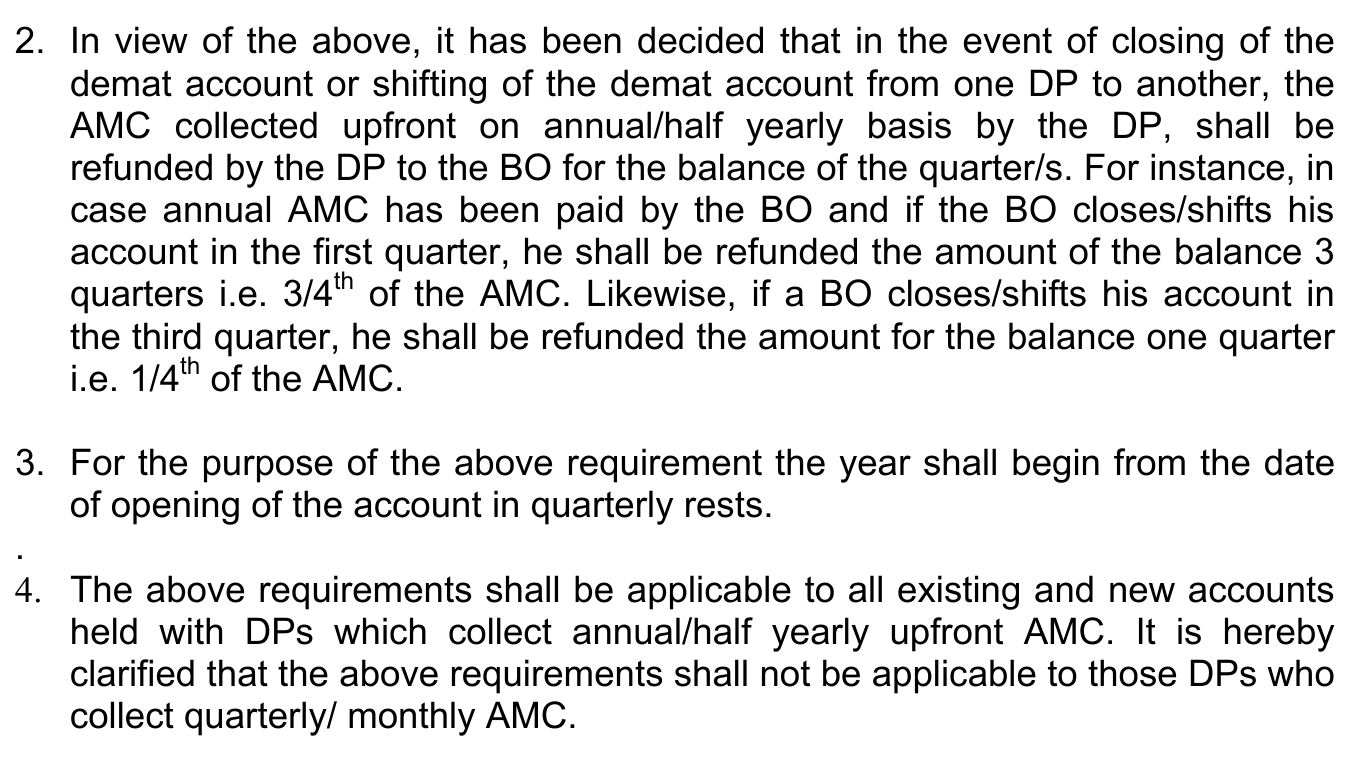
The visual translates the quarter rule; it is not a daily-prorated refund calculator. If your statement has separate tax entries or a different collection pattern, ask the DP how it has applied the rule and recorded the adjustment. For the ongoing maintenance question, use the demat AMC guide.
Track a reference, not a vague promise.
Keep the submitted date, acknowledgement, expected next update and contact channel together. Ask whether the provider has merely received the request or has accepted it as complete. If a document is missing, note the exact requirement and the date you supplied it. That separates time awaiting your response from time awaiting processing.
A useful follow-up is short: “Please confirm the status of closure request [reference], submitted on [date]. I supplied [requested item] on [date]. Is anything still required from me, and when should I expect confirmation?” Attach relevant evidence through the provider’s official private support channel.
Do not infer a universal timeline from another customer’s experience. Zerodha currently quotes two working days for its closure process; that is a provider-specific statement, not a deadline this article assigns to every DP or incomplete application. Current Zerodha timing ↗.
If a case remains unresolved, keep the original request and subsequent replies in one thread where possible. Ask for the outstanding reason in writing. CDSL’s FAQ directs customers with cleared dues and complete documents to the depository’s complaints department if the DP refuses closure. Use the appropriate official grievance route for the depository involved. CDSL FAQ, section 12 ↗.
What proves the account actually closed?
Look for a completion message tied to the account you meant to close. It should let you identify the provider, account reference, outcome and relevant date. If a message merely says “request received”, keep it as an acknowledgement and ask for the completed status separately.
Empty holdings screen
Shows a portfolio state; does not establish account closure.
Account-specific confirmation
Identifies the closure outcome, with a reference and date you can retain.
For closure-cum-transfer, reconcile the securities independently. In a fictional two-holding case, tick each ISIN and quantity against the receiving statement. Then file the old account’s closure confirmation. Do not allow a successful transfer to hide an unfinished closure, or a closure message to replace checking whether every intended security arrived.
Review the final ledger as well. List any promised refund, final payment or adjustment and match it to the actual entry or receipt. Keep an unresolved amount visible in your records until you receive an explanation. The confirmation is the start of your completion check, not a reason to discard all the other evidence.
Use one final note to close your own task: “Account [reference] closed on [date], confirmed by [document]; holdings reconciled to [statement]; cash and adjustments checked to [record].” If you cannot fill one part, leave it marked pending. This creates a concrete trail without collecting unnecessary identity documents or relying on memory months later.
Before you leave the account behind.
Does deleting the app close the demat account?
No. Use the DP’s closure process and obtain confirmation. Removing a local app is not evidence of a change to the account maintained by the provider.
Can I close an account without selling the investments?
Ask about qualifying closure-cum-transfer to a suitable account in the same ownership. The transfer guide explains preparation and receiving-record checks. Restrictions and the account pattern still need to be resolved.
Is the sample letter an official closure form?
No. It is adaptable request wording. Use the official provider form and authentication when required, and keep the letter consistent with the actual account and attachments.
Can I use one broker’s form for another broker?
Use the receiving department’s current accepted document. Similar-looking forms can contain provider identifiers, declarations and receipt sections that are not appropriate elsewhere.
Will closure erase my investment history?
Do not treat closure as a replacement for record keeping. Save purchase evidence and statements beforehand. You may still need them to explain holdings, reporting or a later account query.
Rules, provider steps and original examples.
Checked 18 October 2026. Source dates and capture dates are different: the cited SEBI documents are historical decisions, while current provider guidance supplies operational steps. No personal account was accessed or closed while preparing this guide.
- CDSL account-closure FAQ: requests, channels and unresolved cases ↗
- Zerodha: current closure process, reports and timing ↗
- Groww: official blank closure form and acknowledgement ↗
- SEBI: abolition of closure charges, 31 October 2002 ↗
- SEBI: account-shifting charges, 9 November 2005 ↗
- SEBI: upfront AMC refund, 1 July 2010 ↗
The preparation checklist, form-reading map, sample letter, timeline and hypothetical refund visual are original explanatory components. They do not submit an instruction, replace an official document or claim hands-on account testing.