The small-order cap controls the minimum. A ₹100 order gives ₹2.50 brokerage.
MarketByCountry / India / Brokers / Groww
BROKER RESEARCH / INDIAGroww: where does the cost change?
The ₹0 account-maintenance headline is clear. The price of an equity order depends on its size, a delivery sale adds a DP debit, and one funding mode has a very different brokerage rate.
In this guide Jump to a section
THE SHORT ANSWER
Groww publishes ₹0 account opening and ₹0 demat maintenance for its standard account. For ordinary stock orders, it lists the lower of ₹20 or 0.1% per executed order, with a minimum that particularly affects small orders. A delivery sale can add a separate DP charge. The pricing page also lists 1% uncapped brokerage when equity trades use UPI Mandate balance. Current pricing ↗
Public terms checked 30 Sep 2026Standard resident-individual terms
The ₹5 minimum is conditional.
Groww’s help article says ordinary stock brokerage is the lower of ₹20 or 0.1% of trade value. If that result is below ₹5, a minimum applies, capped at the lower of ₹5 or 2.5% of the order value. That makes a very small order more expensive as a percentage of its value, even though the rupee charge is small. Brokerage rule ↗
EXECUTED ORDER VALUEBROKERAGE FOR THAT ORDER
₹100
₹2.50
₹1,000
₹5.00
₹5,000
₹5.00
₹20,000
₹20.00
These bars show brokerage for one ordinary executed stock order only. A buy and a sell are separate orders. GST and statutory/exchange charges are additional; a delivery sale can also add a DP debit. The examples apply the published minimum rule to the stated order values and round to paise.
One sale can have another charge.
For a standard male first holder, Groww’s DP help lists ₹3.50 depository fee plus ₹16.50 Groww fee, then 18% GST: ₹23.60 for a delivery sale of ₹100 or more. Below ₹100, Groww waives its own ₹16.50 component, but the depository fee plus GST remains: ₹4.13. Female first holders have a slightly lower depository component. DP fee detail ↗
SALE VALUE BELOW ₹100₹4.13Depository fee + GST; Groww fee waived
SALE VALUE ₹100 OR MORE₹23.60Depository + Groww fee + GST
Groww says the DP charge applies per sell order. Selling the same stock in two separate orders can therefore create two debits. The threshold above describes the amount of each debit; it is not a reason to split a sale, since extra orders and execution risk may cost more. Our four-broker DP guide models split-sale patterns. Groww’s counting rule ↗
The standard ₹20 cap does not cover every balance.
Groww’s pricing page separately lists 1% of order value with no maximum cap for equity trades using UPI Mandate balance. For a ₹10,000 executed order, that published special rate is ₹100 before GST; the ordinary stock-brokerage formula gives ₹10 before GST. For ₹50,000, it is ₹500 versus the ordinary ₹20 cap. These compare brokerage only, under the two published modes. Confirm which balance an order would use before applying the standard calculator. Pricing: UPI Mandate balance ↗
₹10,000 ORDER₹10ordinary stock brokerage
→₹10,000 ORDER₹100UPI Mandate balance brokerage
Margin Trading Facility (MTF), NRI accounts, buybacks and OFS transactions also have their own published terms. The ordinary order-size illustration above does not model them. The Zerodha–Groww guide uses standard equity balances and makes its exclusions explicit.
Four zones explain the brokerage formula.
The order-size ladder above gives specific prices. The shape behind it is equally useful: a small-order percentage cap, a flat minimum, the standard percentage and the maximum charge. Treat the following as a map of ordinary equity brokerage before GST. At an exact boundary, the neighbouring formulas give the same amount, so there is no jump in brokerage simply from crossing ₹200, ₹5,000 or ₹20,000.
The minimum is flat. A ₹1,000 order and a ₹4,000 order each give ₹5 brokerage.
The ordinary percentage controls the price. A ₹10,000 order gives ₹10 brokerage.
The ordinary maximum applies. A ₹50,000 order gives ₹20 brokerage.
This map is derived from Groww’s published formula, rather than four separate offers. It explains why “0.1% brokerage” by itself is incomplete. The percentage is not the controlling term at every order size. It also explains why “minimum ₹5” by itself is incomplete: the small-order cap can put the actual amount below ₹5. Published minimum rule ↗
Compare rupees and percentages together.
A ₹5 charge looks modest in isolation, but it is 0.5% of ₹1,000 before GST. The ₹20 charge on ₹50,000 is 0.04%. Neither percentage is the whole trade cost. They are a way of understanding how one service charge scales with the order, and why a budget made entirely of small repeated orders can behave differently from a larger occasional order.
Use executed order value, not the price of one share, to locate the relevant zone. For example, ten shares bought at ₹100 each make a ₹1,000 order. A later sale is another order with its own value, which may differ from the purchase. Applying the buy-side value to both sides hides that difference and can put a sale in the wrong part of the ladder.
Same ₹1,000 sale. Different number of debits.
Consider selling one settled stock for a total of ₹1,000. Compare one ₹1,000 order, two ₹500 orders and five ₹200 orders. Each order is at least ₹100, so the standard male first-holder DP charge in this example is ₹23.60 each. Each also produces ₹5 ordinary brokerage. The sale proceeds are unchanged; the number of chargeable orders is different.
Brokerage including GSTDP including GST
1 sell order × ₹1,000.00₹29.50₹5.90 brokerage with GST + ₹23.60 DP
2 sell orders × ₹500.00₹59.00₹11.80 brokerage with GST + ₹47.20 DP
5 sell orders × ₹200.00₹147.50₹29.50 brokerage with GST + ₹118.00 DP
The visual deliberately isolates the charges affected by the ordinary minimum and the per-order demat rule. It is not a complete sale bill. That separation makes the cause visible: several small orders repeatedly invoke a minimum and a fixed debit. A full estimate also needs the sale’s taxes, exchange charges, rounding and any relevant special circumstances. Groww’s per-order explanation ↗
An order is not the same thing as a share. Selling twenty shares together is different from submitting twenty separate sale orders. Do not estimate the fee by multiplying it by the number of units in your holdings. Likewise, the number of rows in a screenshot is not enough to establish the number of chargeable orders; inspect the actual order and transaction records.
The ₹100 DP threshold is a separate boundary.
The ordinary brokerage map and the delivery-debit threshold answer different questions. A ₹200 order has ₹5 brokerage before GST and, in this standard delivery-sale example, the full DP debit. A sale below ₹100 uses Groww’s stated waiver of its own DP component, while the depository component remains. Do not confuse the lower DP amount with a waiver of brokerage or all transaction charges.
This is an explanation of the bill, not a reason to fragment a disposal around a tariff boundary. More orders can introduce extra execution work, different realised prices and additional minimums. Start from the trade you actually need to make. Use the chart to budget or reconcile that trade, and refer to the DP guide if you need a comparison of charging units across several brokers.
Put the small fees back into the total.
After isolating the moving parts, rebuild a full trade. These three cases each buy one stock and later sell it for exactly the same value through one ordinary NSE delivery order on each side. The account is a resident-individual cash account with a male first holder. The unchanged price is a modeling choice that lets us show charges without mixing in an investment return.
₹37.62
modeled combined trade charges
- Brokerage, both orders
- ₹10.00
- DP, including its GST
- ₹23.60
- Other levies & taxable-fee GST
- ₹4.02
₹69.44
modeled combined trade charges
- Brokerage, both orders
- ₹20.00
- DP, including its GST
- ₹23.60
- Other levies & taxable-fee GST
- ₹25.84
₹182.04
modeled combined trade charges
- Brokerage, both orders
- ₹40.00
- DP, including its GST
- ₹23.60
- Other levies & taxable-fee GST
- ₹118.44
The smallest trade has the lowest rupee bill, but a larger cost relative to the capital changing hands. At the larger size, brokerage reaches its ordinary cap while the value-based levies continue to rise. A capped service fee does not cap the whole bill. This distinction matters when someone describes an account as inexpensive using only its largest advertised brokerage number.
These figures come from the same NSE equity model used in our interactive comparison. It rounds STT to rupees, other displayed fees to paise, and uses the combined exchange-and-IPFT rate supported by the NSE fee circular. Actual account documents can round aggregated activity differently. BSE securities, intraday trades, funded positions and UPI Mandate balance need their own applicable assumptions. Change the trade values ↗
Zero maintenance changes the quiet months.
Groww’s published zero maintenance schedule removes an account-maintenance subtotal from this ordinary account comparison. It does not remove the costs of the months when you transact. For a buy-and-hold investor, distinguish the cost of keeping an account from the cost of accumulating or reducing the portfolio. An account may have no maintenance debit yet still have a meaningful transaction bill over a year.
Build your annual estimate from actual activity categories: purchases, delivery sales, intraday trades and optional services. Do not simply multiply a round-trip estimate by the number of months if you mostly buy without selling. Equally, do not estimate a portfolio disposal using a single DP debit when several orders will be required. The annual pattern should describe your behaviour before it produces a total.
A monthly accumulation plan is not twelve round trips.
Suppose you place one ordinary ₹1,000 equity purchase each month and keep all the shares. Twelve purchases produce ₹60.00 in brokerage, or ₹70.80 with GST on that brokerage. This subtotal excludes the other purchase levies. There is no sale in the stated pattern, so it would be wrong to add twelve sale-side DP charges to this budget.
Now change the behaviour: each purchase is followed by a separate ₹1,000 delivery sale. The twelve extra sale orders add another ₹70.80 in ordinary brokerage including GST and ₹283.20 in standard DP debits. Sale-side levies are additional. The account-maintenance headline is unchanged, but the activity budget is substantially different. The missing input was the investor’s behaviour, not a different AMC schedule.
If several purchases accumulate in one stock and you later dispose of it together, start again with the actual sale value and order count. Do not attach one assumed sell to every historical buy. Recording purchases and planned disposals separately prevents that mistake and gives the calculator a pattern it can meaningfully represent.
Recognise the interface, then check the charge.
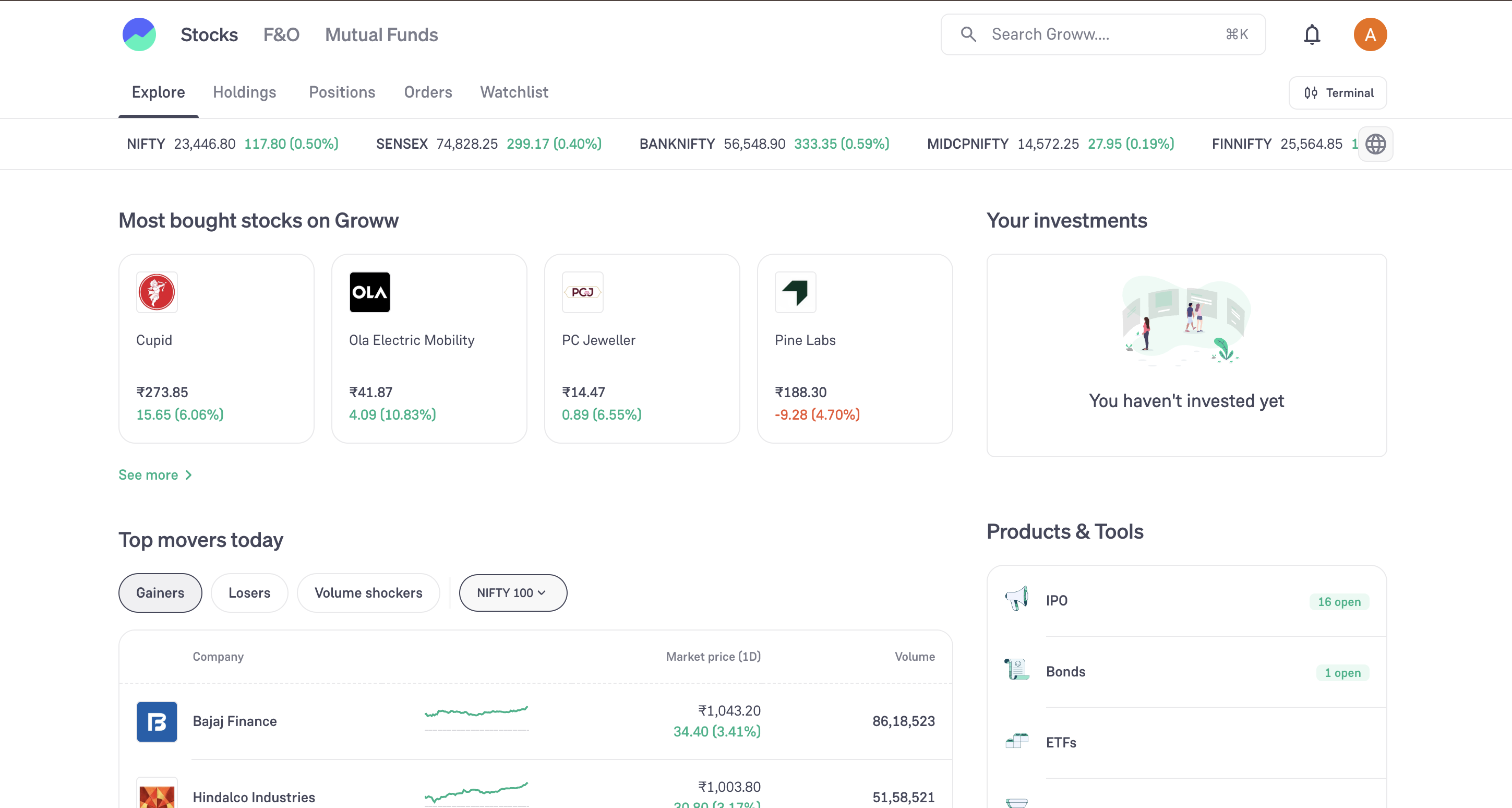
The Explore screen is a discovery surface. To investigate a bill, start with the relevant order and transaction record rather than the popular-stock cards. A market quote answers what a security was priced at on the screen; an executed-order record answers what your transaction actually used. That distinction is essential if you are rebuilding the value on which brokerage was calculated.
Groww’s support page says the order card provides an approximate charge preview below the required margin. Use that estimate to spot an unexpected rate or funding mode before an order is submitted. Save the final account documents for reconciliation afterwards: an approximate preview and an actual posted bill serve different purposes. Where the charge preview appears ↗
Order preview
Check value, segment and approximate charges. If a rate looks different from the ordinary schedule, identify the balance or product involved.
Transaction detail
Match the posted fee to the order. Groww says today’s entries appear after the bill is posted at the end of the day.
Reports
Keep the dated contract note and balance statement. Match the trade with the cash record before calculating a period’s total.
For posted charges, Groww documents Stock F&O Balance, All Transactions and the relevant transaction detail. The contract note can be requested through the profile’s Reports area, under Transactions. The balance statement is also available through Reports for a selected date range. Together, these records allow you to distinguish a trade charge from a movement of cash into or out of the account. Posted fees ↗ Contract note ↗ Balance statement ↗
Five checks before you compare the charge.
- Was the order delivery or intraday? A settled delivery sale can involve a demat debit; the ordinary intraday model does not. Match the segment in the executed record rather than relying on what you originally intended to do.
- Which funding mode applied? Check the specific balance used. The pricing page’s UPI Mandate balance rule is not the ordinary capped brokerage formula. Do not infer a special mode merely from having used UPI for some other payment.
- How many separate orders were executed? Count the sale orders in the records. A combined portfolio value or total quantity does not show how many times the minimum or demat rule was invoked.
- Which parts already include GST? Our DP amounts include GST; the brokerage ladder does not. Adding another 18% to an already inclusive DP figure overstates it. Keep tax treatment explicit for every subtotal.
- Are you reading a completed bill? Wait for the posted record when reconciling the actual deduction, then compare the same day and transaction across reports. Keep estimates labelled as estimates.
If the numbers still do not reconcile, preserve the original documents and note the precise difference. A useful support question includes the order date, security, executed value, transaction description and the rule you expected to apply. “My brokerage seems high” is harder to investigate than “this ordinary ₹1,000 order appears to have a different charge from the published minimum”. Send account-specific material through authenticated support.
For a broker choice, separate the fee question from the workflow question. The current schedule explains what an ordinary order should cost. The interface and reports explain how you manage and verify it. Neither the zero-maintenance headline nor a single screenshot answers every part of the decision. Use your own order sizes, funding mode and sale pattern in the cost tool, then compare the resulting pattern with the Zerodha account guide.
Check the tariff beside the explanation.
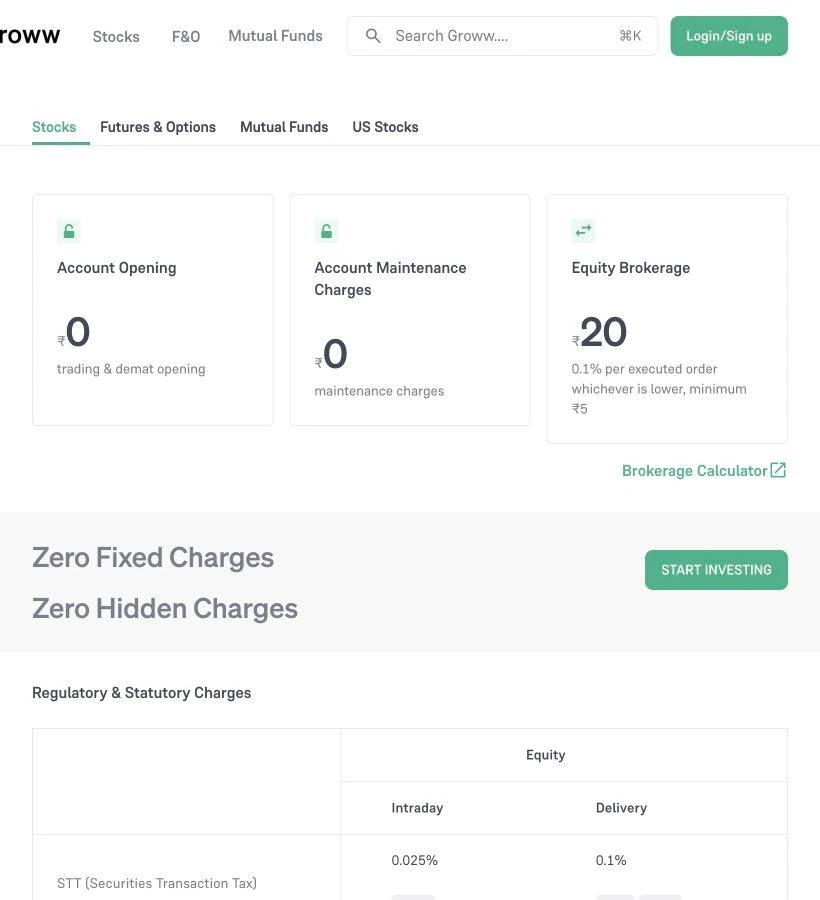
Pricing, ordinary brokerage, DP rules and report-access instructions checked 30 September 2026. Refresh this guide when the tariff, per-order charging rule or funding modes change. The historical screenshot above is retained as a dated illustration; the linked pricing page is the current source.
Publisher: Ashutosh KhulbeResearch methodDisclosures and corrections
Source-check dates refer to the cited documents and the scope described in each guide.