What is the difference between a LIC and an ETF?
A listed investment company (LIC) gives you shares in a company that manages an investment portfolio. A typical Australian fund ETF gives you units in an open-ended fund. Both can trade on an exchange, but their capital structures and price-to-assets relationships differ.
For a LIC, examine its market price alongside reported net tangible assets per share, or NTA. For an ETF, examine the quote alongside net asset value, or NAV, and the trading spread. Neither comparison tells you whether the portfolio itself is suitable. ASX’s introductions explain the company structure; our ETF beginner’s guide covers the fund and trading mechanics.
A widening discount can outweigh an increase in backing per share. The worked example below shows how, without using a live product or forecasting a return.
Start with the investment exposure you need to understand, then compare the wrapper. A broad Australian share portfolio and a narrow overseas strategy are different investments before you consider whether either is a LIC or an ETF. This guide concerns structural questions for Australian investors, not a ranking of products or an allocation recommendation. ASX investment-company overview ↗.
LIC and ETF: a side-by-side comparison.
Use this as a reading map. It describes LICs and typical Australian-domiciled fund ETFs; foreign-domiciled and other exchange-traded products need their own documents. Individual portfolios, costs and distribution arrangements still vary.
The main structural references are ASX’s investment-vehicle introduction ↗ and Macquarie’s ETF structure explanation ↗. Their details matter more than a shorthand such as “LICs are active; ETFs are passive”. A comparison that starts with that shorthand may accidentally compare two strategies rather than two structures.
Buying on an exchange does not make the structures identical.
Company governance and capital decisions sit between the shareholder and the portfolio.
The fund’s governing documents define its strategy and unit arrangements.
ASX describes LICs as public companies and explains that closed-ended vehicles do not issue and cancel securities merely because investors enter and leave through exchange trades. They can raise capital at other times. An ordinary sale transfers the investor’s holding to a buyer; it is not normally a request to have the portfolio liquidate assets for that seller. ASX capital-structure explanation ↗.
Imagine two investors agreeing to trade 100 existing LIC shares. The buyer pays the seller, through the market’s trading and settlement arrangements. The transaction does not by itself give the investment manager new cash to invest. A separate share issue is a different event. Calling a LIC “closed-ended” describes that distinction; it does not promise that the number of shares will remain unchanged forever.
An ETF has an additional creation-and-redemption process involving the issuer and authorised participants. This can adjust units on issue in response to demand. Retail investors ordinarily use the exchange, rather than treating a fund’s NAV as a guaranteed cash-out quote. Keep the retail order and the fund-level process as two different layers. MoneySmart’s ETF explanation ↗.
This is also why your account screen is not the whole ownership story. The broker provides access and records, while the investment vehicle determines the exposure. For checking a HIN, sponsor or custody arrangement, use the separate CHESS holdings guide. The wrapper question and the account-registration question both matter; one does not answer the other.
Active versus passive is another decision.
ETFs can follow an index or use active management. MoneySmart explicitly distinguishes the approaches. A LIC’s investment policy also needs reading: “Australian shares” is a broad description, not a list of holdings, weights or constraints. ETF strategy types ↗.
Suppose a fictional LIC holds a concentrated selection of Australian companies and an ETF follows a broad Australian index. If one performs differently, the explanation could include stock selection, cash, sector weights, fees and the share-price discount. It would be misleading to attribute the entire difference to the legal wrapper. First identify what each manager is trying to achieve.
What does it invest in?
Regions, asset types, concentration, cash and any borrowing or derivative exposure.
How do I participate?
Company share or fund unit, pricing reference, capital arrangements and payment policy.
A useful test is to cover the product names and read only your descriptions. Can you still explain why the portfolios belong in the same comparison? If one is designed for a different market or purpose, stop calling the difference a LIC-versus-ETF result. You may still compare them, but you need to acknowledge the extra investment decision you are making.
Read the date and basis before calculating a discount.
NTA measures tangible assets after liabilities, divided by the relevant securities on issue. MoneySmart tells readers to check the valuation date and whether the published number is before or after tax. A recent share quote paired with an older asset value is a comparison across two dates, not a fresh valuation of everything inside. NTA checks in MoneySmart’s LIC guide ↗.
A$4.50 ÷ A$5.00 − 1 = −10% → a 10% discount.
A$5.50 ÷ A$5.00 − 1 = +10% → a 10% premium.
The denominator matters. The A$0.50 difference between A$4.50 and A$5 is 10% of the A$5 backing, but 11.11% of the A$4.50 purchase price. Those percentages answer different questions. A 10% discount disappearing does not produce merely a 10% price increase if the backing stays unchanged.
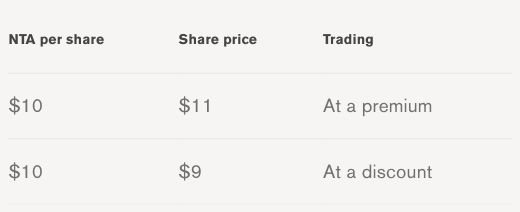
Keep the issuer’s exact label beside the number you use. Do not quietly swap a pre-tax measure for an after-tax measure because one creates a more attractive discount. If the release shows several measures, record each definition and use a consistent basis across the dates in your calculation. Differences in valuation method or timing belong in the notes, not hidden inside a spreadsheet cell.
For an ETF, ASX explains NAV and indicative NAV alongside market prices. Those references can help assess the quote, but are not identical to a guaranteed execution price. A spread, timing differences or stressed markets can matter. Our ETF quote example separates bid, ask and asset value. ASX NAV and trading guidance ↗.
A rising portfolio can still leave a lower share price.
Start with a fictional LIC whose NTA is A$5 per share and whose shares cost A$4.50. You buy 1,000 shares for A$4,500 before dealing costs. Now assume ending NTA reaches A$5.50. That is a 10% increase in backing per share. The price you could receive still depends on the premium or discount at the end.
Value of 1,000 shares. Starting cost A$4,500. Bars begin at zero. Excludes dividends, tax, fees, spreads and corporate actions; these are price-only scenarios, not total returns.
All three rows use the same ending backing. Only the market’s price relative to that backing changes. In the third row, A$5.50 multiplied by 80% gives A$4.40 per share, which is below the A$4.50 paid. The example isolates the mechanism; it does not predict which discount any real LIC will command.
What if the portfolio rises but the discount widens?
Positive discount means below NTA; a negative number represents a premium. This is arithmetic, not a valuation or forecast. Assumes a constant share count, comparable NTA bases and no dividends, taxes, brokerage, spreads or corporate actions. Ending NTA is an input, not a gross return from which fees should automatically be deducted again.
Try keeping ending NTA equal to starting NTA while changing the ending discount. Then hold the discount constant and change ending NTA. Separating the variables makes it easier to see what your investment thesis actually requires. “The portfolio will do well” and “the discount will narrow” are two assumptions, not one.
AFIC’s dated discussion of premiums and discounts identifies performance, costs, dividends and market demand as relevant considerations. It also warns that a discount is not automatically an opportunity. Its 2022 commentary is background about the mechanism, not evidence of today’s AFIC valuation. AFIC’s explanation, dated 28 April 2022 ↗.
If your case depends on selling close to backing, write down what could bring that about and what you would do if the gap persisted. Do not call the gap cash you can already withdraw. Buying at a discount and accessing the underlying assets at their reported value are different propositions.
Dividends, distributions and your overall result.
A LIC’s board decides its dividends. Company profits can be retained, and LICs may pay franked dividends; neither a payment nor a franking outcome is universal. ASX explains the company-level tax and dividend structure. ASX company and trust distinctions ↗.

For ETFs, read the distribution policy for the actual fund. Macquarie’s FAQ describes variable, non-guaranteed distributions. Do not assume two funds distribute on the same schedule, or that the last payment will repeat. Company dividends and fund distributions should be compared using their own documents. Issuer explanation of ETF distributions ↗.
Consider an invented holding bought for A$1,000. It pays A$60 during the period and is worth A$970 at the end. Ignoring costs and tax, the combined change is A$30: A$970 plus A$60 minus A$1,000. The cash payment is 6% of the original investment, while that simple overall result is 3%. Calling only the cash amount “the return” leaves out half the story.
This arithmetic does not claim the payment caused the price movement. It shows why income and capital need separate columns before you combine them. Keep the period, reinvestment assumption and treatment of fees consistent when comparing reported performance. A portfolio return, a share-price return and your personal holding result can be different measures.
Tax treatment needs the actual dividend or annual fund statement and your circumstances. This guide does not calculate franking-credit eligibility, a refund, a LIC capital-gain deduction or an after-tax winner. If a comparison relies on one of those outcomes, add the relevant current tax guidance before drawing the conclusion. A company structure alone does not settle an individual investor’s tax result.
Internal management does not mean no costs.
Argo provides a useful real-world counterexample to blanket assumptions about LIC fees: it describes itself as internally managed, without fees paid to an external manager. That says something about the management arrangement. It does not mean running the company consumes no resources. Read operating expenses in the financial statements as well as any charges billed directly to shareholders. Argo’s management model ↗.
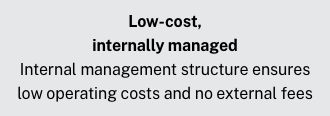
Imagine two purely hypothetical products with comparable exposure: one has an assumed annual cost rate of 0.35%, the other 0.20%. On an unchanged A$20,000 base for a year, those assumptions correspond to A$70 and A$40. The difference is A$30. These are invented rates, not LIC or ETF market averages, and the calculation is not a full fee model.
A$70 on A$20,000
Constant one-year base, before additional excluded costs.
A$40 on A$20,000
A$30 difference under these assumptions only.
Before using published percentages, check their definitions, asset bases and periods. A historical expense ratio and a forward-looking fee schedule are not automatically equivalent. Find any performance-fee terms, portfolio transaction costs and borrowing costs that fall outside the headline. Avoid subtracting the same expenses again from a performance figure already reported after costs.
MoneySmart’s managed-fund selection guidance discusses fees and the need to understand disclosures. Apply the same discipline to the comparison worksheet: separate vehicle costs from brokerage, the bid/ask spread and platform charges. A low advertised trading fee does not tell you the cost of managing the underlying portfolio. MoneySmart on evaluating fund costs ↗.
Put equivalent evidence next to equivalent evidence.
A comparison gets easier when each claim has a document, date and definition. Make a folder for each product and a small note explaining what every file answers. Saving only the glossy factsheet makes it difficult to trace the numbers later.
Company and backing
- Current annual report and financial statements.
- Latest NTA release, with valuation date and basis.
- Investment policy, portfolio updates and announcements.
- Applicable prospectus or other offer material, including later changes.
Fund and trading
- Current PDS, supplements and fee disclosures.
- Factsheet, objective, holdings information and dates.
- NAV and any available iNAV reference.
- TMD, distributions and relevant issuer announcements.
MoneySmart’s LIC guide identifies annual reports, investment updates, announcements and available offer documents as relevant evidence. A company prospectus is not simply an ETF PDS with another name. Match the document to the investment’s structure and check for subsequent changes. Official pre-investment checks ↗.
Now align the measurements. If one performance series reinvests income and the other only tracks market prices, do not put them into a winner column. If one portfolio disclosure is several months older, flag that before analysing concentration. A clear “not comparable yet” is a better result than a precise-looking difference built from mismatched inputs.
The minimum note for a price-to-backing calculation is the quote date and time, the backing valuation date, the exact NTA or NAV label and the formula used. Add any exclusions beside the result. That record lets another reader reproduce your arithmetic without assuming they can reproduce the price you actually obtained.
Compare two candidates without picking a wrapper first.
Imagine Priya has two fictional candidates for Australian share exposure. One is a LIC and one an ETF. She first writes down their objectives and large exposures. If those do not serve the same purpose, she has identified a strategy difference before reaching the price comparison.
- Name the exposure. Describe the assets, concentration and objective without referring to recent returns.
- Check the price reference. Record the quote and the dated NTA or NAV basis. For a LIC, explain the discount or premium in plain language.
- Separate costs and income. Compare defined rates, payment policies and performance measures over aligned periods.
- Challenge the exit assumption. Ask how the result changes if the discount persists, the spread widens or you cannot sell at the displayed quantity.
- Keep the unanswered question. A missing disclosure is something to resolve, not a reason to fill the cell with a generic industry assumption.
Suppose Priya likes a LIC’s investment approach but her entire expected gain relies on its discount disappearing quickly. The scenario tool gives her a way to test that dependency. It does not tell her what will happen. Conversely, an ETF trading close to NAV can still have unsuitable exposure, concentration or costs. A tidy pricing relationship is not a verdict on the investment.
The useful outcome is a short explanation you can defend: what the product owns, why it belongs in the comparison, how the price relates to backing and what might make your assumptions fail. There is no need to produce a universal “LICs win” or “ETFs win” conclusion when the available evidence is product-specific.
Questions that often blur the comparison.
Is a LIC the same as a LIT?
No. A LIC is a company; a listed investment trust is a trust. ASX treats both as listed investment vehicles but explains important structural and tax differences. Do not carry a company-dividend assumption into a trust comparison.
Does a discount guarantee a bargain?
No. The arithmetic tells you the price relative to a particular backing measure. It does not establish the assets’ future value, your exit price or why the gap exists. Try a persistent or wider discount before assuming the gap closes.
Are ETFs always index funds?
No. Active ETFs exist. If you want index exposure, verify the benchmark and strategy rather than inferring them from the ETF label. The existing ETF guide explains this distinction.
Can a LIC issue new shares?
Yes. Closed-ended describes the structure; it does not rule out a capital raising or buyback. Treat those events separately from investors trading existing shares on the exchange.
Official evidence and original examples.
Sources checked 23 October 2026. MoneySmart’s LIC page was updated 17 September 2026; its ETF page 1 September 2026. Screenshots show cropped public pages, not private accounts or executed trades. AFIC’s illustrative table is not a live valuation, and its 2022 article is used only for structural background.
- ASIC MoneySmart: LICs, LITs and NTA checks ↗
- ASIC MoneySmart: ETF structure and strategy ↗
- ASX: investment companies and trusts ↗
- ASX: investment-vehicle introduction ↗
- ASX: ETF trading and asset-value references ↗
- AFIC: educational premium/discount table ↗
- AFIC: explanation dated 28 April 2022 ↗
- Argo: internal management arrangement ↗
- Macquarie: ETF structure and distribution FAQ ↗
- MoneySmart: selecting and checking a managed fund ↗
All scenario prices, backing changes, cost rates and income arithmetic are original hypothetical examples. Recheck the guide when official structural guidance, issuer arrangements or source screenshots change. No current product fee ranking, live discount feed, personal tax calculation or hands-on broker test is claimed.